
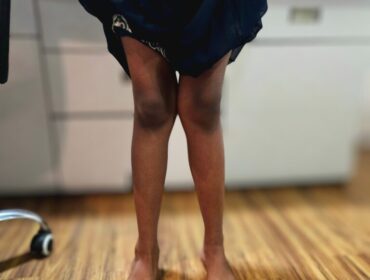
Has your child started walking with knees touching each other and feet wide apart?
If yes, your child may have a condition called “Knock Knees” or Genu Valgus.
Parents often worry when they notice changes in their child’s walking pattern. One of the most common concerns is knock knees in children, a condition where the knees angle inward while standing or walking. Although this can be a normal part of growth, it sometimes needs medical attention.
As a pediatric orthopedic specialist, I often meet parents from Indore, Bhopal, Ujjain, and nearby regions who are unsure whether their child’s knock knees are normal or a problem. This page is designed to give you clarity, reassurance, and the right medical direction.
What Are Knock Knees (Genu Valgus) ?
Knock knees is a condition where your child’s knees bend inward and touch each other while standing, even though their ankles stay apart.
It is quite common between 2 to 6 years of age and often corrects naturally as the child grows. However, in some children, it becomes more severe or persists even after age 7 — this is when medical evaluation is important.
Why Understanding Knock Knees in Children Is Important
While many parents are told to “wait and watch,” it is important to understand that not all knock knees in children are harmless. If left unchecked in abnormal cases, the condition can lead to:
- Uneven stress on knee joints
- Early knee pain during sports
- Poor posture and walking fatigue
- Long-term joint wear in adulthood
Early evaluation helps us differentiate between normal growth-related knock knees and conditions that require treatment.
Causes of Knock Knees in Children
While mild knock knees are part of normal growth, some children develop abnormal angulation due to:
Vitamin D or calcium deficiency (rickets)
• Injury to growth plate
• Bone infections in early childhood
• Obesity or rapid growth
• Genetic or metabolic bone disorders
Sometimes, knock knees can also be a sign of an underlying bone disease — which is why proper diagnosis by an orthopedic specialist is essential.
Some children have one leg more affected than the other — this is a red flag for early correction.
How Knock Knees Affect a Child’s Daily Life
Children with untreated or severe knock knees may:
- Trip or fall more often
- Avoid running or sports due to discomfort
- Feel self-conscious about leg appearance
- Develop knee or ankle pain over time
Addressing knock knees in children early improves not just leg alignment, but also confidence and mobility.
How to Identify Knock Knees at Home
Here’s a simple guide for parents:
✅ Normal – Knees touch slightly, gap between ankles less than 2 inches.
⚠️ Abnormal – Knees strongly touch but ankles stay apart more than 3 inches.
❗ Concerning – Child complains of pain, limp, or has one leg more bent than the other.
If you notice these signs, it’s time to visit a pediatric orthopedic clinic.
Why Clinical Evaluation Matters More Than Online Advice
Every child grows differently. What looks mild in one child may worsen in another. That is why physical examination, growth assessment, and imaging are critical before deciding on treatment.
Diagnosis at Dr. Anupam Khandelwal’s Clinic – Indore
At our Indore clinic, we begin with:
X-rays (to assess growth plates & bone angles)
Scannogram (ONG )
Clinical exam for gait and alignment
Blood tests for Vitamin D, calcium, thyroid levels
With this data, we can precisely determine whether your child’s deformity is physiological (normal) or pathological (needs correction).
We also measure mechanical axis deviation, which helps plan whether your child needs simple exercises, bracing, or a minor corrective surgery.
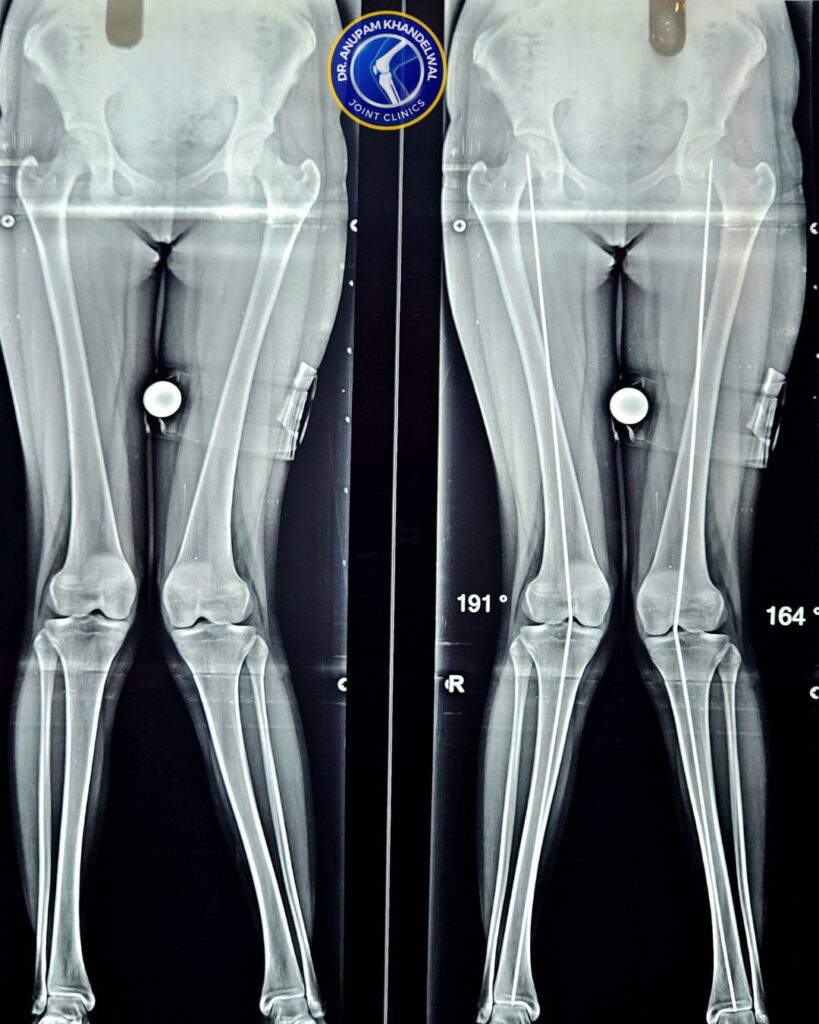
X-ray demonstrating inward knee angulation in a patient with knock knees.
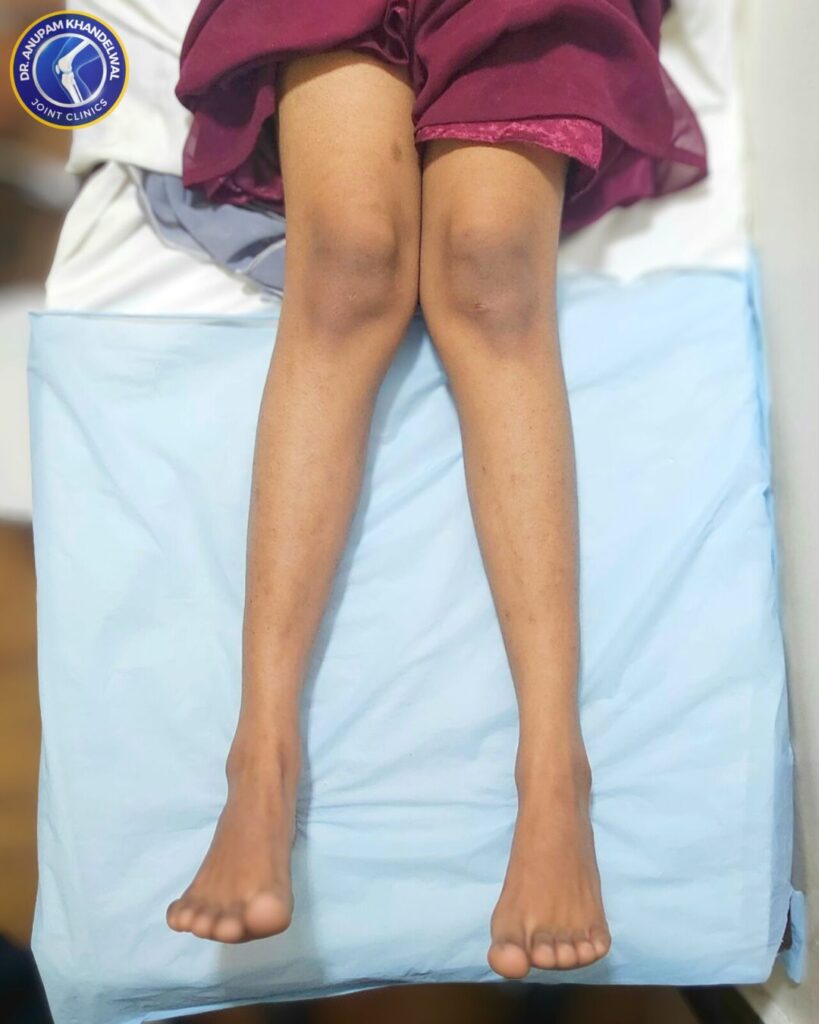
Patients with knock knees often visit our clinic with concerns about leg alignment, walking pattern, or knee appearance.
Treatment Options for Knock Knees
The goal of treatment is straight, pain-free legs with normal growth and confidence.
1️⃣ Observation & Nutritional Support (for mild cases)
For young children with mild knock knees:
• Regular follow-up every 6 months
• Vitamin D & calcium supplements
• Outdoor play & sunlight
• Leg strengthening exercises
Most mild deformities improve naturally with growth and nutrition!
2️⃣ Bracing and Physiotherapy
In growing children with mild to moderate deformity, we sometimes recommend:
• Night-time knee braces
• Physiotherapy to strengthen quadriceps & hamstrings
• Weight management for overweight children
Braces gently guide bone growth while maintaining mobility.
3️⃣ Guided Growth Surgery (Hemiepiphysiodesis)
For children aged 8–13 years with moderate deformity:
• Tiny plates (“8-plates”) are placed near the growth plate
• It guides the leg to straighten naturally as the child grows
• No plaster, minimal scar, and next-day walking
• Correction occurs gradually over 6–12 months
It’s a safe, daycare procedure performed under short anesthesia.
4️⃣ Corrective Osteotomy (for older teens or severe cases)
When bone growth is nearly complete (usually after 14 years), a surgical correction is done:
• Bone is cut precisely at the deformity
• Re-aligned using a small metal plate or rod
• Healing takes around 8–10 weeks
• Results are long-lasting and symmetrical
At our Indore center, we use 3D planning and minimally invasive techniques for faster, safer recovery.
When Should You Consider Surgery?
You should discuss surgical correction if:
• Your child is older than 8 years and the deformity is worsening
• The gap between ankles > 3 inches
• There is pain, limping, or unequal leg length
• The deformity affects sports or confidence
Remember, early surgery = simpler correction + better growth results.
“The right time is when growth plates are open and correction is still possible!”
Post-surgery Recovery
Most children start walking the next day after guided growth surgery! Within weeks, they’re back to school and play. Regular follow-ups help us track the gradual correction — usually complete within 6 to 12 months depending on growth speed.
FAQ
Can knock knees correct naturally?
Yes! Most children under 6 years outgrow mild knock knees naturally. However, if it persists beyond age 7–8, consult an orthopedic specialist..
Is the surgery painful or risky?
No. It’s a minor, low-risk procedure done under anesthesia. Kids usually go home the same day and walk the next morning.
At what age should knock knees in children be treated?
If knock knees in children do not improve by the age of 7–8 years, or if the deformity is increasing, medical evaluation and treatment planning should be done.
When should I consult an orthopedic doctor in Indore for knock knees?
Parents should consult an orthopedic doctor in Indore at Dr. Anupam khandelwal joint clinic if the child has pain, limping, uneven leg alignment, or difficulty walking due to knock knees.
Are braces helpful?
Mild cases may benefit from bracing or physiotherapy, but structural deformities need guided correction.
Does vitamin D deficiency cause knock knees in children?
Yes, vitamin D and calcium deficiency can contribute to knock knees in children. Blood tests help identify deficiencies, and early treatment can prevent progression.
Who is the best doctor for knock knees in children in Indore?
Parents looking for the best doctor for knock knees in children in Indore often consult Dr. Anupam Khandelwal, who specializes in pediatric orthopedic deformities and growth-related knee conditions.
Which doctor should I consult for knock knee treatment in Indore?
For accurate diagnosis and proper treatment of knock knees in Indore, parents should consult a pediatric orthopedic specialist. Dr. Anupam Khandelwal in Indore is experienced in evaluating and treating knock knees in children using modern, age-appropriate techniques.
Where does Dr. Anupam Khandelwal treat knock knees in Indore?
Dr. Anupam Khandelwal treats children with knock knees at his joint and pediatric orthopedic clinic in Indore, where detailed clinical evaluation, imaging, and personalized treatment planning are provided.
Can adults with knock knees be treated?
Yes, adults may require osteotomy (bone correction) surgery, which gives excellent cosmetic and functional results.
In Hindi (हिन्दी में)
“बच्चों के टेढ़े घुटने (नॉक नीज़) सही उम्र में पहचानने और इलाज से पूरी तरह ठीक हो सकते हैं।” “अगर बच्चा दर्द या असमान चाल दिखा रहा है, तो जांच देर न करें।” “डॉ. अनुपम खंडेलवाल के अनुभव से बच्चों को नया आत्मविश्वास और स्वस्थ चाल मिलती है।”
For African & Swahili-speaking Parents
Watoto wenye magoti yaliyopinda wanaweza kutibiwa kabisa!
Dr. Anupam Khandelwal anatibu watoto kwa njia salama na upasuaji wa kisasa huko Indore, India.
Uponaji wa haraka, maumivu kidogo, na matokeo bora!