

Knee pain is one of the most common problems seen in orthopedic clinics today. Many patients from Indore, Bhopal, Ujjain, and nearby parts of Madhya Pradesh visit with complaints of knee locking, swelling, or pain while walking. One frequent reason behind these symptoms is a meniscus tear.
As an orthopedic surgeon, I often explain to patients that the knee is a complex joint. Inside the knee are two small cartilage cushions called the menisci. These structures act like shock absorbers and help the knee move smoothly. However, sudden twisting, sports injuries, or age-related degeneration can cause the meniscus to tear.
What is a Meniscus?
The meniscus is a crescent-shaped cartilage located between the thigh bone (femur) and the shin bone (tibia). Each knee has two menisci:
- Lateral meniscus – located on the outer side of the knee
- Medial meniscus – located on the inner side of the knee
Their main functions include:
- Absorbing shock during walking and running
- Distributing body weight across the knee joint
- Providing stability to the knee
When this cartilage gets damaged, it can affect normal movement and cause significant discomfort.
What is a Meniscus Tear?
A meniscus tear occurs when the cartilage cushion inside the knee gets damaged or torn. This can happen suddenly during sports activities or gradually due to wear and tear.
In younger individuals, the tear is usually caused by twisting injuries. On the other hand, older adults may develop degenerative tears due to aging cartilage.
Fortunately, modern orthopedic care offers effective solutions, and the best meniscus tear treatment in Indore focuses on preserving the natural knee structure whenever possible.
Common Causes of Meniscus Tear
Several factors can lead to this condition.
Sports Injuries
Athletes involved in football, cricket, badminton, or running often experience sudden knee twists that can tear the meniscus.
Sudden Knee Rotation
Even a simple movement like turning quickly while the foot is planted on the ground can cause injury..
Sudden Knee Rotation
With age, the cartilage becomes weaker and more prone to tearing.
Accidents or Falls
Road accidents or falls can also damage the meniscus along with other knee structures.
Symptoms of a Meniscus Tear
The symptoms may vary depending on the severity of the tear. Common signs include:
- Knee pain, especially while bending or twisting
- Swelling around the knee
- Difficulty straightening the leg
- A locking or catching sensation in the knee
- Reduced range of motion
If these symptoms persist for more than a few days, it is advisable to consult the best doctor for meniscus tear treatment in Indore for proper evaluation.
How is Meniscus Tear Diagnosed?
Diagnosis typically involves a combination of clinical examination and imaging tests.
Physical Examination – The orthopedic doctor checks knee movement, swelling, and tenderness.
MRI Scan – MRI is the most reliable test to confirm the presence and type of meniscus tear.
X-ray – Although X-rays do not show cartilage tears, they help rule out fractures or arthritis.
Early diagnosis allows timely management and prevents long-term joint damage.
Meniscus Tear Treatment: Surgical and Non-Surgical Options
The treatment of a meniscus tear depends on several factors such as the size of the tear, location of the injury, patient’s age, and activity level. Not every meniscus injury requires surgery. In fact, many patients recover well with conservative care.
Non-Surgical Treatment for Meniscus Tear
For small or stable tears, doctors usually start with non-surgical treatment. This approach focuses on reducing pain and allowing the knee to heal naturally.
1. Rest and Activity Modification
Reducing activities that strain the knee is the first step. Patients are often advised to avoid running, squatting, and sudden twisting movements until symptoms improve.
2. Ice and Anti-Inflammatory Medication
Ice application and anti-inflammatory medicines help reduce swelling and discomfort around the knee joint.
3. Physiotherapy
Physiotherapy is an important part of recovery. Strengthening exercises for the quadriceps and hamstring muscles help support the knee and improve stability. Benefits of physiotherapy include:
- Reduced knee pain
- Improved joint movement
- Better muscle strength
- Faster recovery
4. Knee Bracing
Surgical Treatment for Meniscus Tear
When symptoms persist despite conservative treatment, or when the tear is large or causing knee locking, surgery may be recommended. Modern orthopedic surgery usually uses arthroscopy, a minimally invasive technique.
1. Arthroscopic Meniscus Repair
If the tear occurs in a region with good blood supply, the surgeon may repair the torn cartilage using special sutures. Repairing the meniscus helps preserve the natural cushioning of the knee.
2. Partial Meniscectomy
If the damaged part cannot be repaired, the surgeon removes only the torn fragment while preserving as much healthy meniscus as possible.
Advantages of Arthroscopic Surgery
- Smaller incisions
- Less pain after surgery
- Faster recovery time
- Short hospital stay
- Early return to daily activities
Patients seeking the best meniscus tear treatment in Indore often benefit from these modern minimally invasive techniques. Patients from Indore, Bhopal, Ujjain, and other parts of Madhya Pradesh frequently consult Dr. Anupam Khandelwal for specialized knee care. With a focus on personalized treatment plans, modern orthopedic techniques, and long-term joint health, he is considered by many patients as a reliable option for Meniscus Tear treatment in Indore.
Recovery Timeline After Meniscus Tear Treatment
Recovery varies depending on whether the injury is treated conservatively or surgically. However, most patients return to normal activity with proper rehabilitation.
First Week
During the initial phase, swelling and pain gradually reduce. Rest, ice, and medication help control inflammation.
2–4 Weeks
Physiotherapy begins to improve knee movement and strengthen surrounding muscles. Light walking and daily activities usually become easier during this stage.
2–3 Months
Those who underwent arthroscopic surgery generally return to normal routine activities and low-impact sports.
A structured rehabilitation program plays a major role in achieving the best meniscus tear treatment in Indore outcomes.
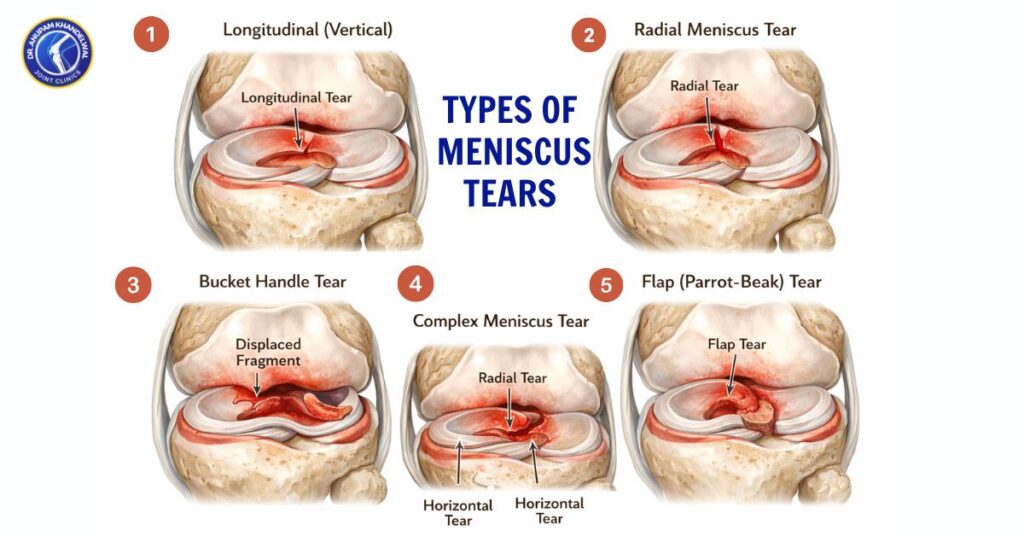
Types of Meniscus Tear
Meniscus tears are classified mainly by the pattern (shape) of the tear seen on MRI or during arthroscopy. Knowing the type helps decide the most appropriate Meniscus Tear treatment in Indore.
1. Radial Tear
This tear starts from the inner free edge of the meniscus and extends outward, like the spokes of a wheel. It is one of the most common meniscus injuries and can disturb the shock-absorbing function of the knee.
2. Horizontal Tear
A horizontal tear splits the meniscus into upper and lower layers.
This pattern is frequently seen in degenerative or age-related injuries and may be associated with knee arthritis.
3. Longitudinal Tear
A longitudinal tear runs parallel to the outer curved edge of the meniscus.
These tears sometimes occur in younger patients after sports injuries.
4. Bucket Handle Tear
A bucket handle tear is a large type of longitudinal tear where a fragment of the meniscus flips into the joint. Typical features include:
- Knee locking
- Difficulty straightening the leg
- Sudden restriction of movement
5. Flap Tear (Parrot Beak Tear )
In this type, a small piece of the meniscus forms a loose flap that can move inside the knee joint. Patients may experience:
- Knee locking
- Catching sensation
- Clicking in the knee
- Pain while bending the knee
6. Complex Tear
A complex tear combines multiple tear patterns such as radial and horizontal tears. It is commonly seen in older adults with degenerative knee cartilage and requires careful evaluation before deciding treatment.
Why Choose Dr. Anupam Khandelwal in Indore for Meniscus Treatment?
Choosing the right orthopedic specialist plays an important role in successful recovery from a knee injury. Dr. Anupam Khandelwal, based in Indore, offers comprehensive evaluation and treatment for patients suffering from meniscus tears and other knee conditions. His approach focuses on careful diagnosis, clear explanation of the problem, and helping patients understand the most suitable treatment options for their knee.
Whenever possible, treatment begins with conservative methods such as physiotherapy, activity modification, and structured rehabilitation. This approach helps many patients recover without surgery. However, if surgery becomes necessary, advanced minimally invasive arthroscopic techniques are used to treat the meniscus tear while preserving as much natural cartilage as possible.
FAQ
Can a meniscus tear heal without surgery?
Yes, many small or stable meniscus tears can heal with non-surgical treatment. Rest, physiotherapy, and medication often help reduce pain and improve knee function. However, larger tears or those causing knee locking may require surgical treatment.
How do I know if my knee pain is due to a meniscus tear?
Common symptoms include knee pain, swelling, stiffness, and a clicking or locking sensation while bending the knee. If these symptoms persist, it is advisable to consult a specialist for proper evaluation and Meniscus Tear treatment in Indore.
How long does it take to recover from a meniscus tear?
Recovery time depends on the type of injury and treatment. Minor tears treated conservatively may improve within a few weeks, while recovery after arthroscopic surgery may take several weeks to a few months with proper physiotherapy.
Is walking safe with a meniscus tear?
Light walking may be possible in some cases, but activities that involve twisting, running, or deep bending should be avoided until the knee heals. A medical evaluation helps determine safe activity levels.
When should I see a doctor for a meniscus injury?
If knee pain, swelling, or difficulty in bending the knee continues for several days after an injury, medical consultation is recommended. Early diagnosis helps prevent further joint damage and ensures the best meniscus tear treatment in Indore.
Hindi Summary (हिंदी सार)
मेनिस्कस टियर घुटने के अंदर मौजूद कार्टिलेज कुशन के फटने को कहते हैं। यह चोट खेलते समय अचानक मुड़ने, गिरने या उम्र बढ़ने के कारण हो सकती है।
मुख्य लक्षणों में घुटने में दर्द, सूजन, लॉक होना और चलने में कठिनाई शामिल हैं।
इलाज के विकल्प: आराम और फिजियोथेरेपी , दवाइयाँ , आवश्यकता होने पर आर्थ्रोस्कोपिक सर्जरी
समय पर इलाज कराने से घुटने की कार्यक्षमता सुरक्षित रहती है और भविष्य में आर्थराइटिस का खतरा कम होता है।
Swahili Summary
Meniscus tear ni jeraha la cartilage ndani ya goti ambalo husaidia kupunguza mshtuko wakati wa kutembea au kukimbia.
Dalili kuu ni: Maumivu ya goti , Kuvimba , Ugumu wa kunyoosha goti , Hisia ya kufunga kwa goti
Matibabu yanaweza kujumuisha dawa, mazoezi ya physiotherapy, au upasuaji mdogo unaoitwa arthroscopy. Kupata matibabu mapema husaidia kuzuia matatizo ya muda mrefu kwenye goti.