
Living with Ankylosing Spondylitis (AS) is challenging enough because of chronic back pain and stiffness. However, many patients are surprised when they begin experiencing severe pain in their hips. In some cases, this pain may be due to Hip Arthritis, while in others, it may be caused by Avascular Necrosis (AVN). Both conditions can significantly affect mobility, independence, and quality of life.
In this article, let’s understand Hip AVN & Arthritis in Ankylosing Spondylitis, why it occurs, how it is diagnosed, and what treatment options are available.
What is Ankylosing Spondylitis?
Ankylosing Spondylitis is a chronic autoimmune inflammatory disease that mainly affects the spine and sacroiliac joints. Over time, inflammation may cause the joints of the spine to become stiff and less flexible.
Although the disease primarily affects the back, nearly one-third of patients may also develop problems in the hip joints. Hip involvement usually indicates more severe disease and requires early attention.
How Does Ankylosing Spondylitis Affect the Hip?
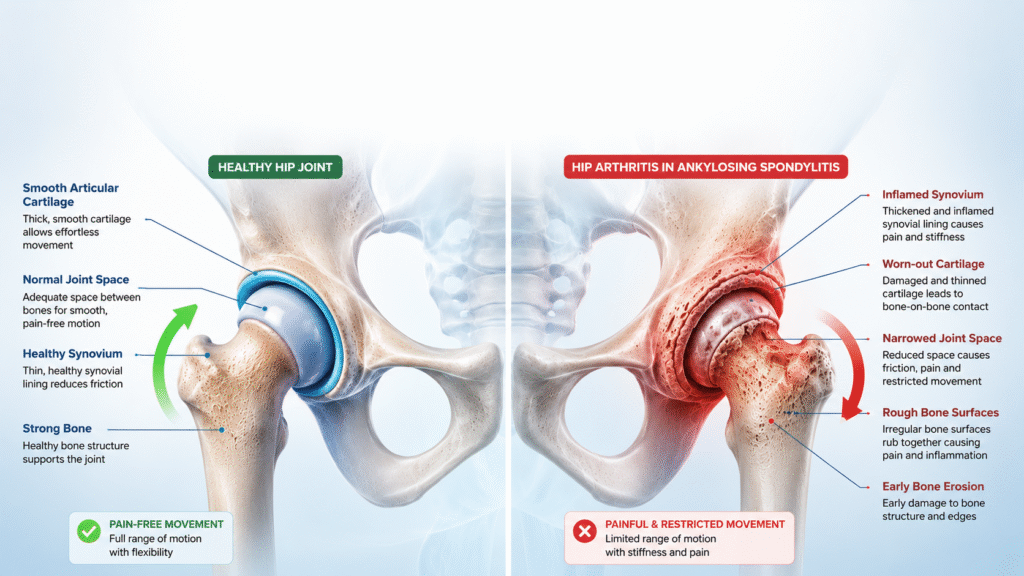
The hip is a weight-bearing joint. Continuous inflammation inside the joint gradually damages the cartilage and surrounding bone.
As the disease progresses:
- Cartilage wears out.
- Joint space becomes narrow.
- Hip movements become painful.
- Walking becomes difficult.
- Stiffness increases.
- Daily activities become limited.
If the condition continues untreated, permanent arthritis may develop.
Understanding Hip Arthritis in Ankylosing Spondylitis
Hip arthritis develops because chronic inflammation slowly destroys the smooth cartilage covering the hip joint.
Common symptoms include:
- Pain in the groin
- Hip pain while walking
- Difficulty climbing stairs
- Morning stiffness
- Limping
- Difficulty sitting cross-legged
- Pain while getting up from a chair
- Reduced hip movement
Patients often notice that they can no longer perform activities that were once easy.
What is Hip AVN?
Avascular Necrosis (AVN) means the blood supply to the femoral head (ball of the hip joint) becomes reduced or completely stops.
Without adequate blood supply, the bone begins to die.
Eventually:
- The femoral head weakens.
- Small fractures develop.
- The bone collapses.
- Severe arthritis follows.
Once collapse occurs, joint-preserving treatment becomes difficult.
Why Can AVN Develop in Ankylosing Spondylitis?
The disease itself does not directly cause AVN. However, several factors increase the risk.
These include:
- Long-term corticosteroid therapy
- High-dose steroid exposure
- Autoimmune disorders
- Reduced blood circulation
- Smoking
- Alcohol abuse
- Previous hip injury
Among these, prolonged steroid use remains one of the most recognized risk factors for developing AVN.
A Rare Case: Quadrilateral AVN in the Post-COVID Era
One of the unusual observations reported during the post-COVID era in 2025 was Quadrilateral AVN, where both hip joints and both shoulder joints were affected simultaneously.
In this reported case, the patient had Ankylosing Spondylitis and had received corticosteroid therapy as part of disease management. Steroid exposure is a well-established risk factor for AVN and is considered a likely contributor to the development of osteonecrosis in all four major joints.
Although Quadrilateral AVN is extremely rare, it highlights the importance of careful steroid use, regular clinical follow-up, and early MRI evaluation whenever patients with Ankylosing Spondylitis develop persistent pain in the hips or shoulders.
It is important to note that long-term steroids are not the standard treatment for Ankylosing Spondylitis. Current treatment primarily focuses on NSAIDs and biologic medications, while corticosteroids are used selectively in specific clinical situations.
Symptoms You Should Never Ignore
Consult an orthopaedic specialist if you experience:
- Groin pain lasting several weeks
- Hip pain even while resting
- Pain at night
- Difficulty walking
- Limping
- Reduced hip movement
- Pain while wearing shoes
- Difficulty climbing stairs
- Shoulder pain along with hip pain
- Sudden worsening of stiffness
Early diagnosis often allows better treatment options.
How is Hip AVN & Arthritis Diagnosed?
A detailed clinical examination is the first step.
Investigations may include:
X-ray
Useful for detecting arthritis and advanced AVN.
MRI
MRI is the best investigation for detecting early AVN before bone collapse occurs.
CT Scan
Sometimes required for surgical planning.
Blood Tests
May be advised to evaluate inflammation and other associated conditions.
Treatment Options
Treatment depends on the stage of disease.
1. Medicines
Your rheumatologist may prescribe:
- NSAIDs
- DMARDs
- Biologic medicines
- Pain-relieving medications
These medicines help control inflammation but cannot reverse advanced AVN.
2. Physiotherapy
Regular physiotherapy helps:
- Improve flexibility
- Reduce stiffness
- Maintain muscle strength
- Improve walking ability
Exercise remains an important part of long-term management.
3. Lifestyle Changes
Patients should:
- Maintain healthy body weight
- Avoid smoking
- Exercise regularly
- Avoid unnecessary steroid use
- Follow medical advice consistently
4. Core Decompression
If AVN is detected before collapse, Core Decompression may improve blood flow inside the bone and delay disease progression.
Selected patients may also benefit from biologic procedures such as Bone Marrow Aspirate Concentrate (BMAC).
5. Hip Replacement Surgery
When arthritis becomes severe or the femoral head collapses, Total Hip Replacement offers the best long-term solution.
Modern hip replacement can:
- Relieve pain
- Improve walking
- Restore movement
- Correct deformity
- Improve quality of life
With advanced surgical planning and minimally invasive techniques, many patients resume daily activities much sooner than expected.
Can Hip Replacement Help Patients with Ankylosing Spondylitis?
Yes Patients with severe Hip AVN & Arthritis in Ankylosing Spondylitis often experience dramatic improvement after hip replacement surgery.
Benefits include:
- Less pain
- Better posture
- Improved walking
- Easier sitting and standing
- Greater independence
Every patient requires individualized planning for the best outcome.
Why Early Diagnosis Matters
The biggest mistake many patients make is ignoring hip pain.
Early diagnosis can:
- Preserve the joint
- Delay surgery
- Improve mobility
- Reduce long-term disability
- Improve quality of life
Persistent hip pain should never be considered “normal” in Ankylosing Spondylitis.
Why Choose Dr. Anupam Khandelwal in Indore?
Dr. Anupam Khandelwal is a renowned Orthopaedic, Hip Replacement and Joint Replacement Surgeon in Indore with extensive experience in managing complex hip disorders.
His practice focuses on:
- Early diagnosis of AVN
- Joint-preserving procedures
- Advanced Hip Replacement Surgery
- Minimally invasive techniques
- Personalized rehabilitation
- Long-term patient follow-up
Patients regularly visit from Indore, Bhopal, Ujjain, Ratlam, Khandwa, Khargone, Jabalpur, Mansaur , and many other cities across Madhya Pradesh for specialized hip care.
Frequently Asked Questions
1. Can Ankylosing Spondylitis affect both hips?
Yes. Both hips may be involved, especially in long-standing disease.
2. Is Hip AVN common in Ankylosing Spondylitis?
It is uncommon but can occur, particularly in patients with significant corticosteroid exposure or other risk factors.
3. What is the difference between Hip Arthritis and AVN?
Hip arthritis results from cartilage damage due to chronic inflammation, whereas AVN occurs because of reduced blood supply leading to bone death.
4. Is MRI necessary?
MRI is the most sensitive investigation for detecting early AVN before X-rays become abnormal.
5. Can AVN heal without surgery?
Very early AVN may be managed with joint-preserving procedures, but advanced stages often require surgery.
6. When is Hip Replacement recommended?
When pain is severe, mobility is limited, and imaging shows advanced joint damage or collapse of the femoral head.
7. Can both shoulders and both hips develop AVN together?
When pain is severe, mobility is limited, and imaging shows advanced joint damage or collapse of the femoral head.
8. Can I walk normally after Hip Replacement?
Most patients regain comfortable walking after rehabilitation and recovery.
9.Where can I get expert treatment for Hip AVN & Arthritis in Ankylosing Spondylitis in Madhya Pradesh?
Patients from Indore and across Madhya Pradesh can consult Dr. Anupam Khandelwal for comprehensive evaluation and advanced hip care.
Swahili Summary
Ankylosing Spondylitis ni ugonjwa wa uchochezi unaoweza kuathiri uti wa mgongo na nyonga. Wagonjwa wanaweza kupata Hip Arthritis au Avascular Necrosis (AVN), hali inayotokea pale damu inapopungua kufika kwenye mfupa wa nyonga. Hii inaweza kusababisha maumivu makali, ugumu wa kutembea na kupungua kwa uwezo wa kusonga. Uchunguzi wa mapema kwa kutumia MRI, dawa sahihi, mazoezi ya tiba na matibabu ya kisasa yanaweza kusaidia. Kwa wagonjwa wenye uharibifu mkubwa wa nyonga, upasuaji wa Hip Replacement unaweza kupunguza maumivu na kurejesha uwezo wa kutembea na kufanya shughuli za kila siku kwa urahisi.
Hindi Summary
Ankylosing Spondylitis एक सूजन संबंधी बीमारी है जो रीढ़ के साथ-साथ कूल्हे के जोड़ को भी प्रभावित कर सकती है। लंबे समय तक बीमारी रहने पर हिप में गठिया (Hip Arthritis) या Avascular Necrosis (AVN) विकसित हो सकता है। AVN में हिप की हड्डी तक पर्याप्त रक्त नहीं पहुँचता, जिससे हड्डी कमजोर होकर बैठ सकती है। लंबे समय तक या अधिक मात्रा में स्टेरॉयड लेने वाले कुछ मरीजों में इसका जोखिम बढ़ सकता है। शुरुआती जांच, विशेषकर MRI, समय पर उपचार में मदद करती है। शुरुआती अवस्था में दवाइयाँ, फिजियोथेरेपी और Core Decompression उपयोगी हो सकते हैं, जबकि गंभीर मामलों में Hip Replacement Surgery से दर्द कम होकर चलने-फिरने की क्षमता में महत्वपूर्ण सुधार आता है।