
PASSION FOR CARING
Revision Hip Replacement Surgery for Infection in Indore
Advanced Treatment for Infected Hip Replacement | Safe, Effective & Specialized Care
- High Success Rate
- Advanced Infection Control Protocols
- Personalized Patient Care
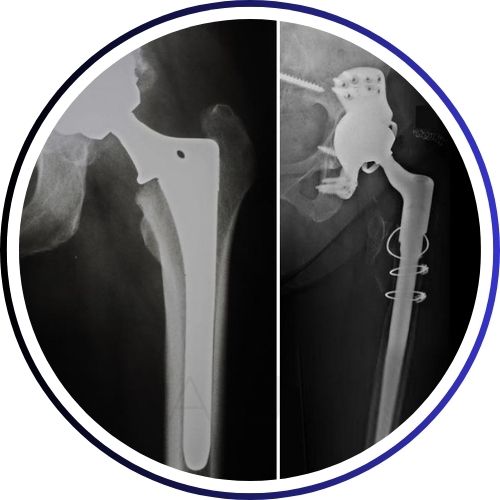
What is an Infected Hip Replacement?
An infected hip replacement, also known as Periprosthetic Joint Infection (PJI), occurs when bacteria affect the artificial hip joint and surrounding tissues.
This is a serious complication that requires timely treatment, as infections around implants do not usually heal with antibiotics alone.
Signs of Infection After Hip Replacement
- Persistent or increasing hip pain
- Swelling and redness
- Warmth around the joint
- Discharge (pus) from the wound
- Difficulty walking
Early diagnosis is crucial to avoid complications and improve success rates.
Why Revision Hip Replacement is Required
Infections form a protective layer called biofilm over the implant, making antibiotics ineffective.
To completely remove infection, the artificial joint often needs to be replaced through revision hip replacement surgery.
Types of Revision Hip Replacement for Infection
Infections form a protective layer called biofilm over the implant, making antibiotics ineffective.
To completely remove infection, the artificial joint often needs to be replaced through revision hip replacement surgery.
What is an Antibiotic Spacer?
An antibiotic spacer is placed temporarily after removing the infected implant.
Functions:
- Delivers high-dose antibiotics
- Maintains joint space
- Allows limited mobility
Recovery After Revision Hip Replacement
After Stage 1
- Limited walking
- IV antibiotics
- Regular blood tests
After 2nd Stage
- Physiotherapy
- Gradual return to walking
- Full recovery in 3–6 months
Risks & Challenges
- Re-infection
- Bone loss
- Dislocation
- Longer recovery
FDG-labelled WBC PET–CT for Diagnosing Infection in Hip Replacement
FDG-labelled white blood cell positron emission tomography–computed tomography provides Advanced Infection Detection in Infected Joint Infections of Knee and Hip Joints
Diagnosing infection after hip replacement surgery can sometimes be challenging, especially in patients with persistent pain, swelling, implant loosening, or previous revision surgeries. In selected complex cases, advanced imaging techniques such as FDG-labelled WBC PET–CT may help identify hidden infection around the artificial hip joint.
Accurate Diagnosis Matters
Early and accurate diagnosis of infection is critical because treatment strategies differ significantly between –
- Simple inflammation
- Implant loosening Deep prosthetic joint inf
- Deep prosthetic joint infection
Proper diagnosis helps the surgeon plan:
- Antibiotic treatment
- Debridement surgery
- One-stage or two-stage revision hip replacement
- Implant retention or replacement
Expert Evaluation is Essential
No single test alone can confirm infection in every patient. FDG-labelled WBC PET–CT is usually interpreted along with –
- Clinical examination
- ESR and CRP blood tests
- Joint aspiration reports
- Culture sensitivity tests
- X-rays and other imaging studies
An experienced revision hip replacement surgeon can combine all these findings to create the safest and most effective treatment plan for infected hip replacement cases.
Call us at +91-8818814030 If you need help to get a FDG PET Scan Study and review in India .
Best Revision Hip Replacement Surgeon in Indore
Dr. Anupam Khandelwal specializes in complex hip surgeries, including infected hip replacement revisions.
- Expertise in infection management
- High success rate
- Comprehensive rehabilitation support
- Advanced surgical techniques
Frequently Asked Questions(FAQ)
for Revision Hip Replacement
What is the success rate of revision hip replacement in infection?
Success rate is around 90–95% with two-stage revision.
Q2: How long does recovery take?
Recovery usually takes 3 to 6 months depending on the patient.
Q3: Can infection come back after surgery?
Rarely, but proper treatment significantly reduces the risk.
Q4: Is revision surgery painful?
Pain is well managed with modern techniques and medications.
Get Expert Treatment for Infected Hip Replacement in Indore
Don’t ignore persistent pain or signs of infection after hip replacement. Early treatment can save your joint and improve outcomes.

- Limited consultation slots available.