
One of the most common questions I hear from patients diagnosed with Avascular Necrosis (AVN) is:
“Doctor, can my hip be saved without Hip Replacement?”
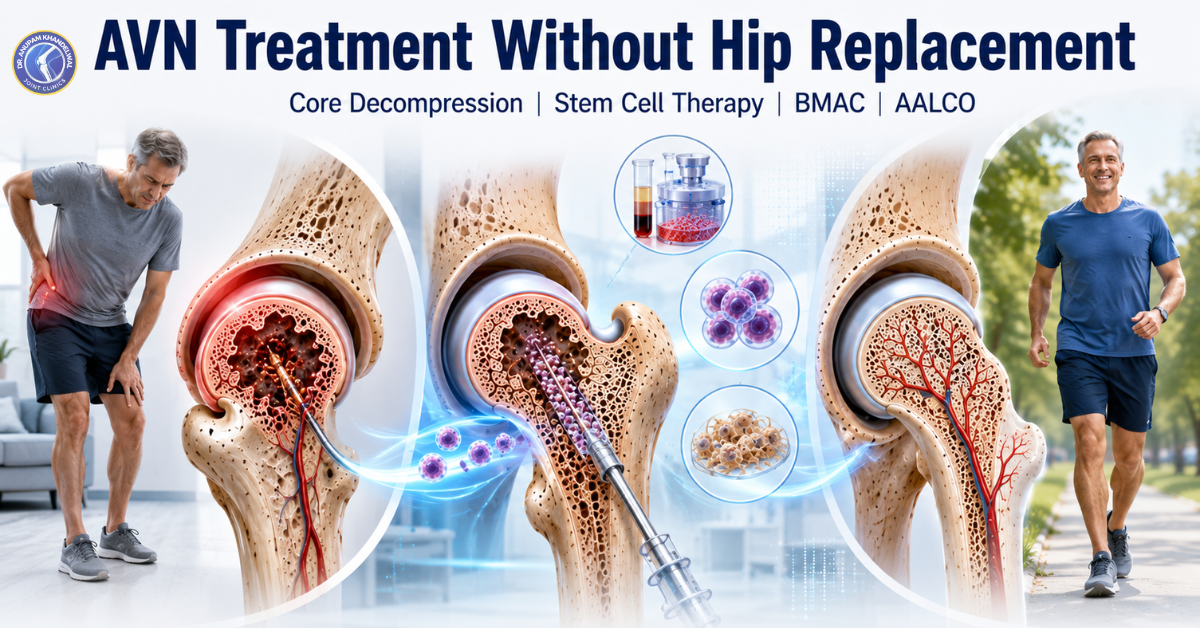
The answer depends on the stage of AVN. When diagnosed early, many patients may benefit from AVN Treatment Without Hip Replacement through advanced hip-preserving procedures. These treatments aim to protect the natural hip joint, improve bone healing, and delay or even avoid the need for Hip Replacement Surgery.
Today, several options are available for Early AVN Treatment, including:
- Core Decompression for AVN
- Hip Stem Cell Therapy
- BMAC for AVN
- AALCO Treatment
- Bone Cell Therapy
- Hip Preservation Surgery
Understanding these treatments can help patients make informed decisions about their hip health.
What is Hip Preservation Surgery?
Hip Preservation Surgery refers to treatments designed to save the patient’s natural hip joint before irreversible damage occurs.
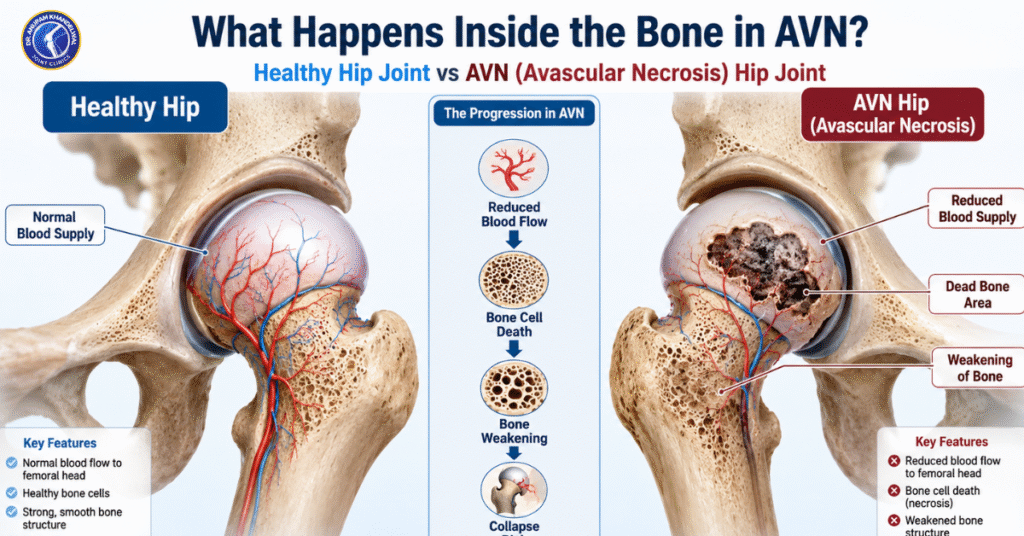
In AVN, the blood supply to the femoral head (the ball of the hip joint) becomes reduced. As a result, bone cells start dying. Over time, the bone weakens and may eventually collapse.
The goal of AVN Hip Saving Surgery is to interrupt this process before significant collapse occurs.
Therefore, early diagnosis plays a critical role in preserving the natural hip.
Understanding What Happens Inside the Hip in AVN
To understand treatment, patients must first understand the problem.
The femoral head is a living structure that continuously receives:
- Blood
- Oxygen
- Nutrients
However, when blood supply decreases, bone cells begin to die. Consequently, healing becomes difficult.
As the disease progresses:
- Blood circulation reduces.
- Bone cells die.
- Internal pressure increases.
- The bone becomes weak.
- The femoral head starts collapsing.
- Arthritis develops.
Fortunately, when AVN is detected before significant collapse, several hip-preserving procedures may help.
Core Decompression for AVN
Core Decompression is a hip preservation surgery used in the early stages of AVN. The aim is to save the patient’s natural hip joint before the femoral head collapses.
In AVN, the blood supply to a portion of the hip bone decreases. As a result, bone cells start dying, pressure builds up inside the bone, and healing becomes difficult.
Core Decompression creates small channels within the damaged bone to reduce pressure and improve blood circulation.
Think of it as creating new pathways inside a blocked road network so that traffic can move again.
Who is Suitable for Core Decompression?
Core Decompression is usually considered for:
Ideal Candidates
- Stage 1 AVN
- Stage 2 AVN
- Early Stage 3A AVN
- Younger patients
- Patients without major collapse
- Patients with preserved cartilage
Less Suitable Candidates
- Advanced AVN
- Severe femoral head collapse
- Advanced arthritis
- Stage 4 disease and beyond
Benefits of Core Decompression
- Preserves the natural hip
- Reduces pressure inside bone
- Improves blood circulation
- Delays disease progression
- Can postpone Hip Replacement
- Minimally invasive surgery
- Small incision
- Short hospital stay
Detailed Process of Core Decompression
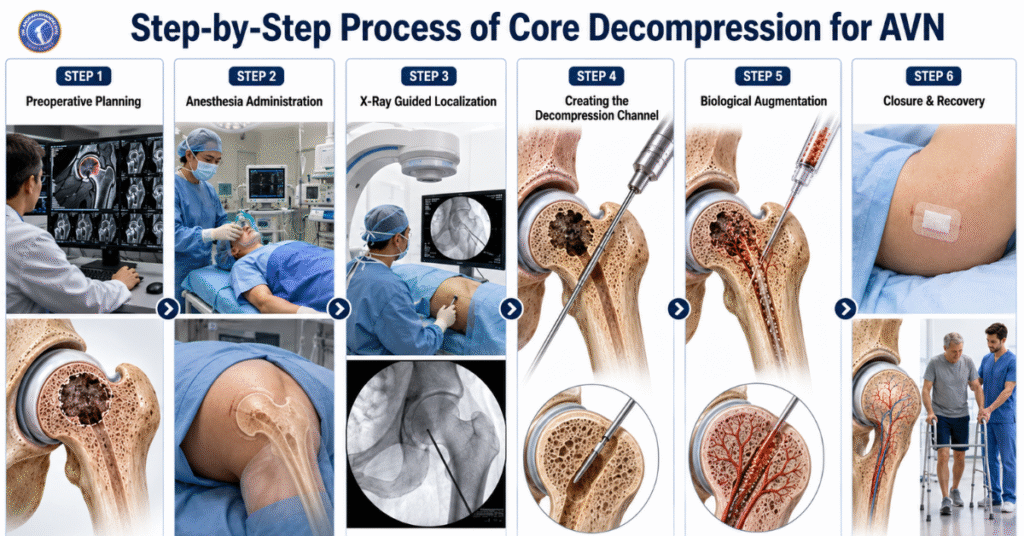
Step 1: Preoperative Planning
MRI scans are reviewed to determine:
- Location of AVN
- Size of lesion
- Stage of disease
The treatment plan is then finalized.
Step 2: Anesthesia
The procedure is usually performed under spinal or general anesthesia.
Step 3: X-ray Guided Surgery
A C-arm machine helps identify the exact AVN area.
Step 4: Creating the Decompression Channel
A guide wire is inserted into the affected region.
Specialized drills are then used to create channels inside the femoral head.
Step 5: Biological Augmentation
Many surgeons combine Core Decompression with:
- BMAC
- Stem Cell Therapy
- Bone Grafting
- AALCO
Step 6: Closure
The incision is closed and dressed.
Hip Stem Cell Therapy for AVN
Hip Stem Cell Therapy is a regenerative treatment that uses the body’s natural healing cells to help repair damaged bone.
The goal is not to replace the hip but to support healing and preservation of the existing joint.
Stem cells act like biological repair managers. They release signals that encourage healing and support bone regeneration.
Who is Suitable for Hip Stem Cell Therapy?
Stem Cell Therapy is generally considered for:
Ideal Candidates
- Early AVN
- Stage 1 AVN
- Stage 2 AVN
- Small to moderate lesions
- Younger active patients
Not Ideal For
- Severe collapse
- Advanced arthritis
- End-stage AVN
Benefits of Stem Cell Therapy
- Biological treatment
- Uses patient’s own cells
- Supports bone healing
- May delay Hip Replacement
- Can be combined with Core Decompression
- Minimally invasive
How Does Stem Cell Therapy Work?
Stem cells may help:
- Improve blood vessel formation
- Promote healing
- Support bone remodeling
- Reduce progression of AVN
It is important to understand that stem cells do not magically create a new hip.
Instead, they create a better healing environment.
Detailed Treatment Process of Stem Cell Therapy
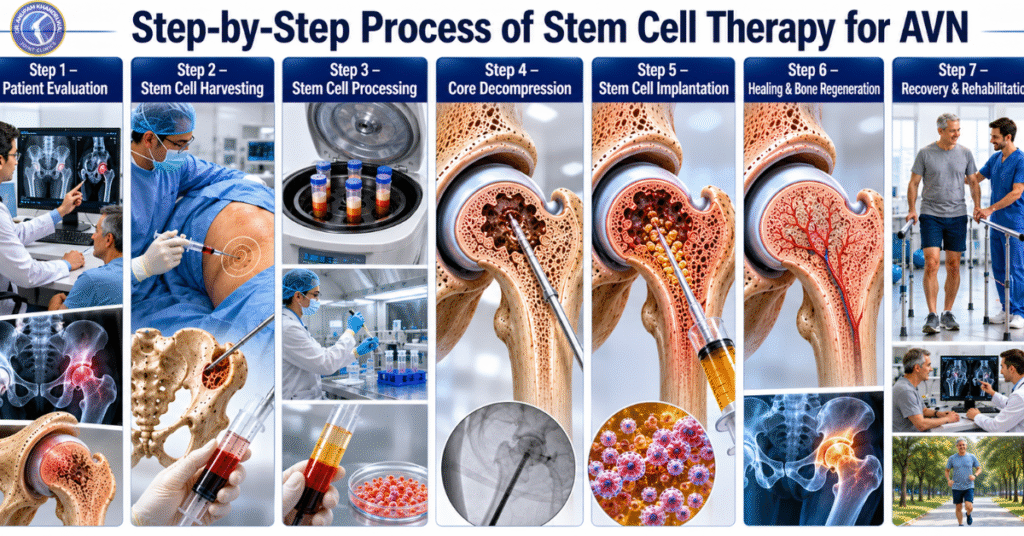
Step 1 – Patient Evaluation
The patient undergoes a detailed clinical examination along with MRI and X-rays to determine:
- Stage of AVN
- Size of the lesion
- Extent of bone involvement
- Suitability for Hip Preservation Surgery
Step 2 – Stem Cell Harvesting
Stem cells are usually obtained from the patient’s own bone marrow.
A specialized needle is inserted into the pelvic bone (iliac crest), and bone marrow is collected under sterile conditions.
Step 3 – Stem Cell Processing
The collected sample is processed to isolate and concentrate regenerative cells.
Depending on the treatment method, the cells may be:
- Concentrated immediately (BMAC)
- Expanded in a laboratory (advanced cell therapies)
Step 4 – Core Decompression
A small channel is created inside the femoral head using specialized orthopedic instruments.
This helps:
- Reduce pressure within the bone
- Improve blood circulation
- Create a pathway for stem cell delivery
Step 5 – Stem Cell Implantation
The processed stem cells are implanted directly into the AVN lesion through the decompression channel.
The goal is to deliver regenerative cells precisely to the damaged area.
Step 6 – Healing and Bone Regeneration
After implantation, stem cells may help:
- Support new blood vessel formation
- Promote bone healing
- Improve bone remodeling
- Slow progression of AVN
This process occurs gradually over several months.
Step 7 – Recovery and Rehabilitation
Patients begin a structured rehabilitation program that may include:
- Protected weight bearing
- Physiotherapy
- Strengthening exercises
- Regular follow-up imaging
Recovery protocols vary depending on the stage of AVN and the specific procedure performed.
BMAC for AVN
BMAC stands for Bone Marrow Aspirate Concentrate.
It is one of the most common forms of stem-cell-based treatment used in AVN.
BMAC uses the patient’s own bone marrow to obtain a concentrated mixture of healing cells.
Who is Suitable for BMAC?
BMAC stands for Bone Marrow Aspirate Concentrate.
It is one of the most common forms of stem-cell-based treatment used in AVN.
BMAC uses the patient’s own bone marrow to obtain a concentrated mixture of healing cells.
Benefits of BMAC
- Same-day procedure
- Uses patient’s own cells
- No laboratory cell expansion required
- Minimally invasive
- Can be combined with Core Decompression
What Does BMAC Contain?
BMAC contains:
- Mesenchymal Stem Cells
- Growth Factors
- Cytokines
- Healing Cells
These components work together to support regeneration.
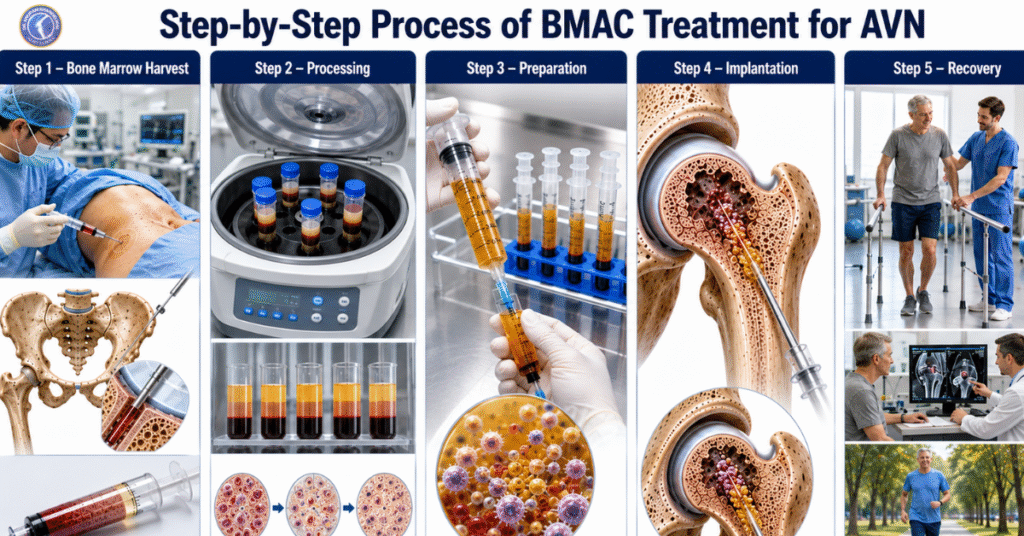
Detailed Treatment Process of BMAC Process
Step 1: Bone Marrow Harvest
A needle is inserted into the pelvic bone.
Bone marrow is collected.
Step 2: Processing
Healing cells are isolated or concentrated.
Step 3: Preparation
The concentrated solution is prepared for implantation.
Step 4: Implantation
Following Core Decompression, BMAC is injected into the AVN lesion.
Step 5: Recovery
Patients begin a structured rehabilitation program.
AALCO Treatment for AVN
AALCO stands for Autologous Adult Live Cultured Osteoblasts.
It is an advanced form of Bone Cell Therapy.
Unlike BMAC, where cells are used immediately, AALCO involves growing and multiplying cells in a specialized laboratory before implantation.
Who is Suitable for AALCO?
AALCO may be considered for:
- Early AVN
- Pre-collapse AVN
- Patients seeking biological hip preservation
- Patients with adequate bone stock
Suitability should always be determined after MRI evaluation and specialist consultation.
Benefits of AALCO Treatment
- Uses patient’s own cells
- Large number of bone-forming cells
- Targets bone regeneration
- Advanced biological therapy
- Designed to preserve the natural hip
Why Are Osteoblasts Important?
Osteoblasts are the body’s natural bone-building cells.
Their function is to:
- Produce new bone
- Strengthen weakened bone
- Support regeneration
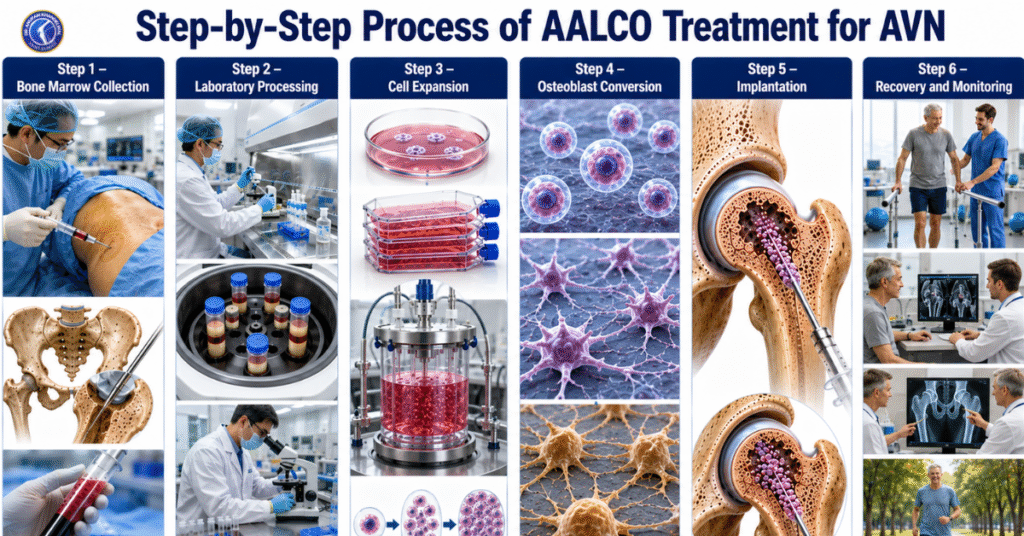
Detailed Treatment Process of AALCO
Step 1: Bone Marrow Collection
Bone marrow is harvested from the pelvic bone.
Step 2: Laboratory Processing
The sample is sent to a specialized cell culture laboratory.
Step 3: Cell Expansion
Selected cells are multiplied over several weeks. Millions of cells are generated.
Step 4: Osteoblast Conversion
The expanded cells are transformed into osteoblasts.
Step 5: Implantation
After Core Decompression, the cultured osteoblasts are implanted into the AVN lesion.
Step 6: Recovery and Monitoring
Patients undergo rehabilitation and periodic imaging follow-up..
Which Option is Best for hip AVN ?
There is no single treatment that is best for every patient.
The choice depends on:
- Stage of AVN
- Size of lesion
- Age of the patient
- MRI findings
- Degree of femoral head collapse
- Activity level
- Treatment goals
The most important factor is early diagnosis. Patients diagnosed before collapse have the highest chance of benefiting from AVN Treatment Without Hip Replacement and preserving their natural hip joint.
AVN Treatment Without Surgery in Indore by Dr. Anupam Khandelwal
Many patients diagnosed with early-stage AVN ask whether surgery can be avoided. The answer depends on the stage of the disease, symptoms, and MRI findings. While advanced AVN often requires surgical intervention, some patients with very early AVN may benefit from non-surgical treatment strategies.
Non-surgical AVN management may include:
- Activity modification and protected weight-bearing
- Physiotherapy and muscle strengthening exercises
- Pain management medications when appropriate
- Vitamin D and bone health optimization
- Management of underlying medical conditions
- Lifestyle modifications such as reducing alcohol consumption and avoiding smoking
- Regular MRI and clinical follow-up
It is important to understand that non-surgical treatment aims to slow disease progression and manage symptoms. It cannot reverse advanced bone damage or femoral head collapse.
Patients from Indore, Bhopal, Ujjain, Ratlam, Jabalpur, Guna, Khandwa, Khargone, and other parts of Madhya Pradesh often seek expert evaluation to determine whether they are candidates for AVN Treatment Without Hip Replacement or whether surgical hip preservation procedures may provide better long-term outcomes.
Success Factors in AVN Treatment
The success of AVN treatment depends on several important factors. Understanding these factors helps patients develop realistic expectations and make informed treatment decisions.
1. Stage of AVN
The stage of disease is one of the most important factors influencing outcomes.
Generally:
- Stage 1 AVN has the highest potential for hip preservation.
- Stage 2 AVN may still respond well to treatment.
- Early Stage 3 AVN can sometimes be treated with hip-preserving procedures.
- Advanced collapse often requires Hip Replacement Surgery.
2. Early Diagnosis
Early diagnosis provides the best opportunity to preserve the natural hip joint.
Patients who undergo MRI evaluation before femoral head collapse usually have more treatment options available.
3. Size of the AVN Lesion
Smaller lesions often have better outcomes than large lesions involving a significant portion of the femoral head.
4. Patient Age
Younger patients with good bone quality may experience better healing potential and may be stronger candidates for Hip Preservation Surgery.
5. Lifestyle Factors
Smoking, excessive alcohol intake, and poor compliance with treatment recommendations can negatively affect recovery and long-term results.
6. Underlying Cause of AVN
Outcomes may vary depending on whether AVN is related to:
- Steroid use
- Alcohol consumption
- Trauma
- Sickle Cell Disease
- Autoimmune disorders
7. Post-Treatment Rehabilitation
Following weight-bearing restrictions, physiotherapy protocols, and follow-up schedules plays an important role in recovery and long-term success.
हिंदी सारांश
एवैस्कुलर नेक्रोसिस (AVN) एक ऐसी स्थिति है जिसमें हिप की हड्डी तक रक्त की आपूर्ति कम हो जाती है, जिससे हड्डी कमजोर होने लगती है। यदि AVN का समय पर पता चल जाए, तो Hip Replacement के बिना भी उपचार संभव हो सकता है। Core Decompression, Hip Stem Cell Therapy, BMAC और AALCO Treatment जैसी आधुनिक Hip Preservation Surgery तकनीकों का उद्देश्य प्राकृतिक हिप जोड़ को बचाना और हड्डी की मरम्मत में सहायता करना है। हर मरीज के लिए उपचार उसकी AVN की स्टेज, MRI रिपोर्ट, उम्र और हड्डी की स्थिति के अनुसार तय किया जाता है। इसलिए लगातार हिप दर्द या चलने में कठिनाई होने पर जल्द से जल्द ऑर्थोपेडिक विशेषज्ञ से परामर्श लेना आवश्यक है। समय पर उपचार से कई मरीजों में AVN Treatment Without Hip Replacement संभव हो सकता है।
Muhtasari kwa Kiswahili
Avascular Necrosis (AVN) ni hali ambapo usambazaji wa damu kwenye mfupa wa nyonga hupungua, na kusababisha mfupa kudhoofika. Ikiwa AVN itagunduliwa mapema, inawezekana kutibu bila kubadilisha nyonga (Hip Replacement) kwa wagonjwa waliochaguliwa. Matibabu kama Core Decompression, Hip Stem Cell Therapy, BMAC na AALCO yanalenga kuhifadhi nyonga ya asili na kusaidia uponaji wa mfupa. Uchaguzi wa matibabu hutegemea hatua ya AVN, matokeo ya MRI, umri wa mgonjwa na kiwango cha uharibifu wa mfupa. Uchunguzi wa mapema na matibabu sahihi huongeza nafasi ya kuhifadhi nyonga ya asili na kuboresha ubora wa maisha.
Frequently Asked Questions (FAQs)
1. Can AVN be treated without Hip Replacement?
Yes, many patients with early-stage AVN may be candidates for AVN Treatment Without Hip Replacement. Depending on MRI findings and disease stage, treatments such as Core Decompression, Stem Cell Therapy, BMAC, and AALCO may help preserve the natural hip joint.
2. What is the best treatment for early AVN of the hip?
The best treatment depends on the stage of AVN, lesion size, age of the patient, and MRI findings. In many early cases, Hip Preservation Surgery options such as Core Decompression, Stem Cell Therapy, BMAC, or AALCO may be considered before Hip Replacement.
3. What is Core Decompression for AVN?
Core Decompression is a minimally invasive procedure that creates channels inside the femoral head to reduce pressure, improve blood supply, and promote healing. It is commonly used as an Early AVN Treatment before significant bone collapse occurs.
4. Is Stem Cell Therapy effective for AVN?
Stem Cell Therapy aims to support bone healing and regeneration by delivering regenerative cells to the damaged area. It is often combined with Core Decompression in selected patients with early-stage AVN.
5. What is the difference between Stem Cell Therapy, BMAC, and AALCO?
BMAC uses concentrated bone marrow cells obtained and implanted on the same day. AALCO involves laboratory expansion of cells and conversion into bone-forming osteoblasts before implantation. Both are forms of regenerative or Bone Cell Therapy used in selected AVN patients.
6. Which AVN stages are suitable for Hip Preservation Surgery?
Hip Preservation Surgery generally offers the best results in:
- Stage 1 AVN
- Stage 2 AVN
- Selected early Stage 3 AVN
Once significant collapse and arthritis develop, Hip Replacement Surgery may provide more predictable outcomes.
7. Can Core Decompression prevent Hip Replacement?
In some patients, Core Decompression may delay or help avoid Hip Replacement by improving blood flow and supporting healing. However, outcomes depend on disease stage, lesion size, and patient-specific factors.
8. How do I know if I am a candidate for AVN Treatment Without Hip Replacement in Indore?
A detailed clinical examination, MRI evaluation, and specialist consultation are required to determine whether Hip Preservation Surgery is suitable. Early diagnosis provides the highest chance of preserving the natural hip joint.
9. What is the success rate of Hip Preservation Surgery for AVN?
Success depends on several factors, including disease stage, lesion size, patient age, underlying cause of AVN, and compliance with rehabilitation. Earlier treatment generally leads to better outcomes.
10. How long does recovery take after Core Decompression or Stem Cell Therapy?
Recovery varies depending on the procedure performed and the severity of AVN. Most patients require a period of protected weight-bearing, physiotherapy, and regular follow-up imaging during recovery.
11. Is MRI necessary before AVN treatment?
Yes. MRI is considered the most important investigation for staging AVN and planning treatment. It can detect AVN before changes become visible on X-rays.
12. What happens if AVN is left untreated?
Untreated AVN may gradually progress from bone weakening to femoral head collapse and eventually arthritis of the hip joint. Early intervention often provides more treatment options and better chances of hip preservation.
13. Can a young patient with AVN avoid Hip Replacement?
Many younger patients with early-stage AVN are evaluated for hip-preserving procedures because preserving the natural hip joint is generally preferred whenever possible. The decision depends on MRI findings, lesion size, and the extent of femoral head damage.
14. Where can I get treatment for AVN in Indore, Bhopal, Ujjain, Ratlam, Jabalpur, or Guna?
Patients from Indore, Bhopal, Ujjain, Ratlam, Jabalpur, Guna, Khandwa, Khargone, and across Madhya Pradesh often seek specialist consultation for AVN evaluation and Hip Preservation Surgery options. Early MRI assessment can help determine the most appropriate treatment pathway.
15. Is Hip Stem Cell Therapy available in Indore?
Stem-cell-based regenerative procedures, including BMAC and other biological treatment options, may be considered for selected AVN patients after detailed evaluation by an orthopedic specialist.