

Symptoms and Stages of Avascular Necrosis (AVN):Early Signs & Treatment of Avascular Necrosis (AVN) in Indore
AVN symptoms depend on how advanced the condition is. In the early stages, symptoms are usually mild and often ignored. Although Avascular Necrosis (AVN) treatment in Indore is easily available, its success largely depends on how early these symptoms are identified. Unfortunately, when early AVN symptoms are overlooked, timely diagnosis and treatment get delayed, allowing the condition to progress further.
Early Symptoms of AVN
In the early stage, patients may experience:
- Mild pain while walking or standing for long periods
- Discomfort after physical activity
- Pain that improves with rest
- Occasional stiffness in the joint
- No visible swelling or redness
Many patients assume this pain is due to muscle strain, ageing, or long working hours. Since X-rays often appear normal at this stage, AVN remains undiagnosed unless an MRI is done.
Why Recognizing Avascular Necrosis (AVN) Early Symptoms Is Critical
Avascular Necrosis (AVN) is a condition in which the blood supply to the bone gradually reduces, as a result of which the bone starts weakening over time. However, the biggest challenge is that in the early stages, symptoms of AVN are very mild and therefore often ignored by patients. Because of this, diagnosis is frequently delayed. On the other hand, early diagnosis of Avascular Necrosis (AVN) can help save the natural joint, whereas late diagnosis may eventually lead to joint collapse and the need for joint replacement surgery.
Stages of Avascular Necrosis
AVN progresses through well-defined stages. Identifying the stage helps in deciding the most effective treatment plan.
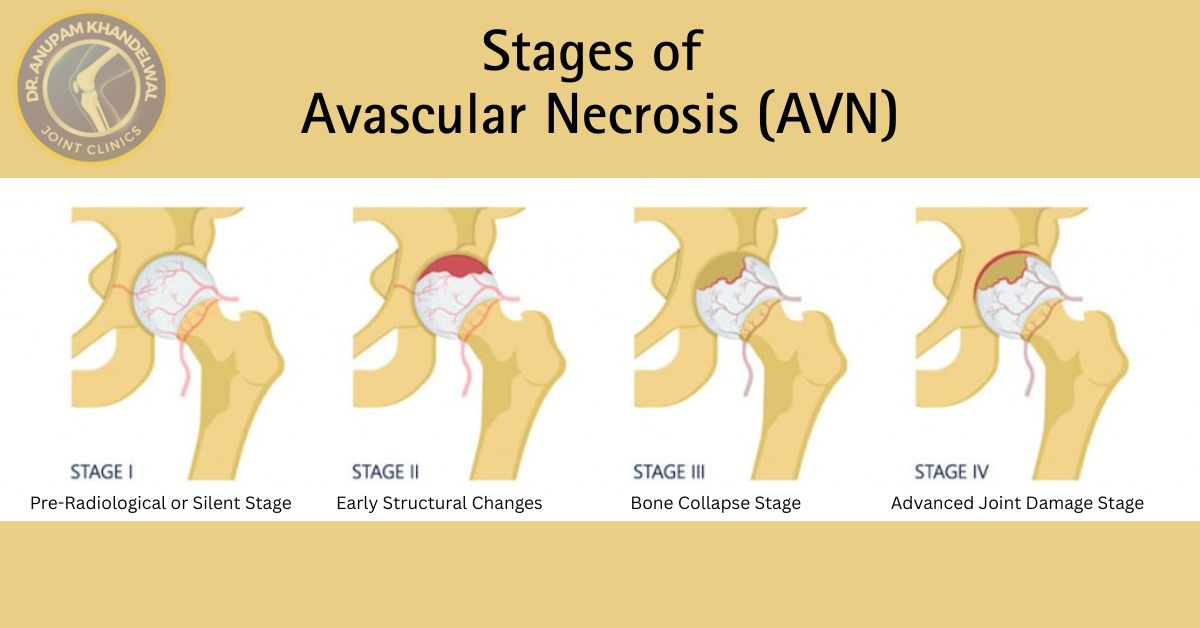
This is the earliest stage of AVN and the most commonly missed.
- X-rays appear normal
- MRI shows reduced blood supply to the bone
- Meanwhile, there may be mild pain or sometimes no pain at all
- Bone structure remains intact
Patients continue their normal lifestyle during this stage. However, this is the best stage for joint-preserving treatment if diagnosed early.
In this stage, the disease becomes more noticeable.
- Pain increases during walking or activity
- At this stage, X-rays may show early changes in bone density
- MRI confirms AVN clearly
- Internal bone structure starts weakening
Many patients from Indore, Bhopal, and Ujjain present at this stage, often after months of pain.
This is a critical stage in the progression of AVN.
- Pain becomes persistent
- Pain occurs even during rest
- As the condition progresses, the surface of the bone begins to collapse
- Joint movement becomes painful and limited
Once bone collapse starts, treatment options become more limited. Early surgical intervention may still help in selected cases.
This is the final and most severe stage of AVN.
- As the condition worsens, severe pain occurs during daily activities
- Pain Persists Even at Rest
- .Marked Reduction in Joint Movement
- Noticeable Limping and Functional Limitation
At this stage, joint replacement surgery is usually the most effective option to relieve pain and restore mobility.
Early Symptoms of Avascular Necrosis (AVN) (Stage 1 & 2)
These stages are dangerous because X-rays may look normal; however, symptoms have already started.
1️⃣ Mild Pain in the Joint
Pain appears during:
- Walking
- Standing for long time
- Climbing stairs
- Pain reduces with rest
Many patients say:
“Doctor, chalne par thoda dard hota hai, par baithne par theek ho jata hai.”
This is often an early symptom of Avascular Necrosis (AVN).
2️⃣ Groin, Thigh or Buttock Pain (Hip AVN)
In hip Avascular Necrosis (AVN), pain may be felt in:
- Primarily, the groin area
- Front or side of thigh
- Buttock region
- Sometimes pain is felt in the knee (referred pain)
This is very common in patients coming from Bhopal and Ujjain.
3️⃣ As the condition progresses, joint stiffness may develop :
- Sitting cross-legged
- Getting up from the floor
- Rotating the hip or knee
- In some cases, mild morning stiffness may occur
4️⃣ Gradually, the patient starts walking with a mild limp.
- Initially, the patient starts walking with a mild limp.
- Limp increases after longer walks
- This limp is an important early sign of Avascular Necrosis (AVN).
Symptoms of Avascular Necrosis (AVN) Based on Joint
- Hip Avascular Necrosis (AVN)
- Groin pain
- Thigh pain
- Limping
- Difficulty sitting cross-legged
- Knee Avascular Necrosis (AVN)
- Knee pain while walking
- Swelling
- Difficulty climbing stairs
- Shoulder Avascular Necrosis (AVN)
- Shoulder pain on lifting the arm
- Stiffness
- Reduced rotation
Best AVN Treatment Options in Indore: Early Diagnosis & Advanced Care
AVN treatment options in Indore
Avascular Necrosis (AVN) is Explore the best AVN treatment options in Indore, including advanced non-surgical therapies, joint-saving procedures, and expert orthopedic care, ensuring timely diagnosis and effective management of Avascular Necrosis (AVN).
हिंदी में सारांश (Hindi Summary)
एवैस्कुलर नेक्रोसिस (Avascular Necrosis – AVN) के शुरुआती लक्षण हल्के होते हैं, जैसे चलने पर दर्द, जॉइंट में जकड़न और हल्की लंगड़ाहट।
समय पर इलाज न होने पर दर्द बढ़ता जाता है और आराम करते समय भी दर्द होने लगता है।
अंतिम अवस्था में जॉइंट खराब हो सकता है और सर्जरी की आवश्यकता पड़ सकती है।
Summary in Swahili
Dalili za Avascular Necrosis (AVN) huanza polepole kama maumivu madogo ya kiungo wakati wa kutembea.
Kadri ugonjwa unavyoendelea, maumivu huonekana hata wakati wa kupumzika.
Utambuzi wa mapema wa AVN unaweza kusaidia kuokoa kiungo bila upasuaji mkubwa.
1. Are early symptoms of Avascular Necrosis (AVN) severe?
No, early symptoms of Avascular Necrosis (AVN) are often not severe, starting subtly as mild aches or stiffness, especially with activity.
2. Can Avascular Necrosis (AVN) cause limping?
Yes, limping is a common symptom, especially in hip AVN.
3. Does AVN pain occur at night?
In advanced stages of Avascular Necrosis (AVN), pain can occur even at night..
4. Can AVN symptoms be mistaken for muscle pain?
Yes, early AVN pain is often confused with muscle strain.
5. Is AVN treatment available in Indore?
Yes, advanced AVN treatment is available in Indore with modern techniques.
6. . Which joint is most commonly affected by AVN?
The hip joint is most commonly affected.
7. Can AVN be present without symptoms?
Yes, in the very early stage, AVN may not cause noticeable symptoms.
8. How does AVN affect walking?
As AVN progresses, walking becomes painful and limping may start.
9. How does AVN pain increase with time?
Pain starts slowly, then becomes more frequent and severe as the disease progresses.