
Complex Elbow Fracture-Dislocation Care in Indore
Terrible Triad Elbow Injury Treatment
Terrible triad elbow injury is a serious fracture-dislocation pattern involving elbow dislocation, radial head fracture and coronoid fracture, usually with ligament injury.
This injury is treated as an instability problem of the elbow, not as a simple dislocation. The radial head, coronoid process and collateral ligaments work together to keep the elbow reduced through movement.
CT scan planning is commonly required after reduction because treatment depends on radial head reconstructability, coronoid fragment size, joint congruity, subluxation and ligament stability. The aim is a stable elbow that can start protected movement as early as the reconstruction safely permits.
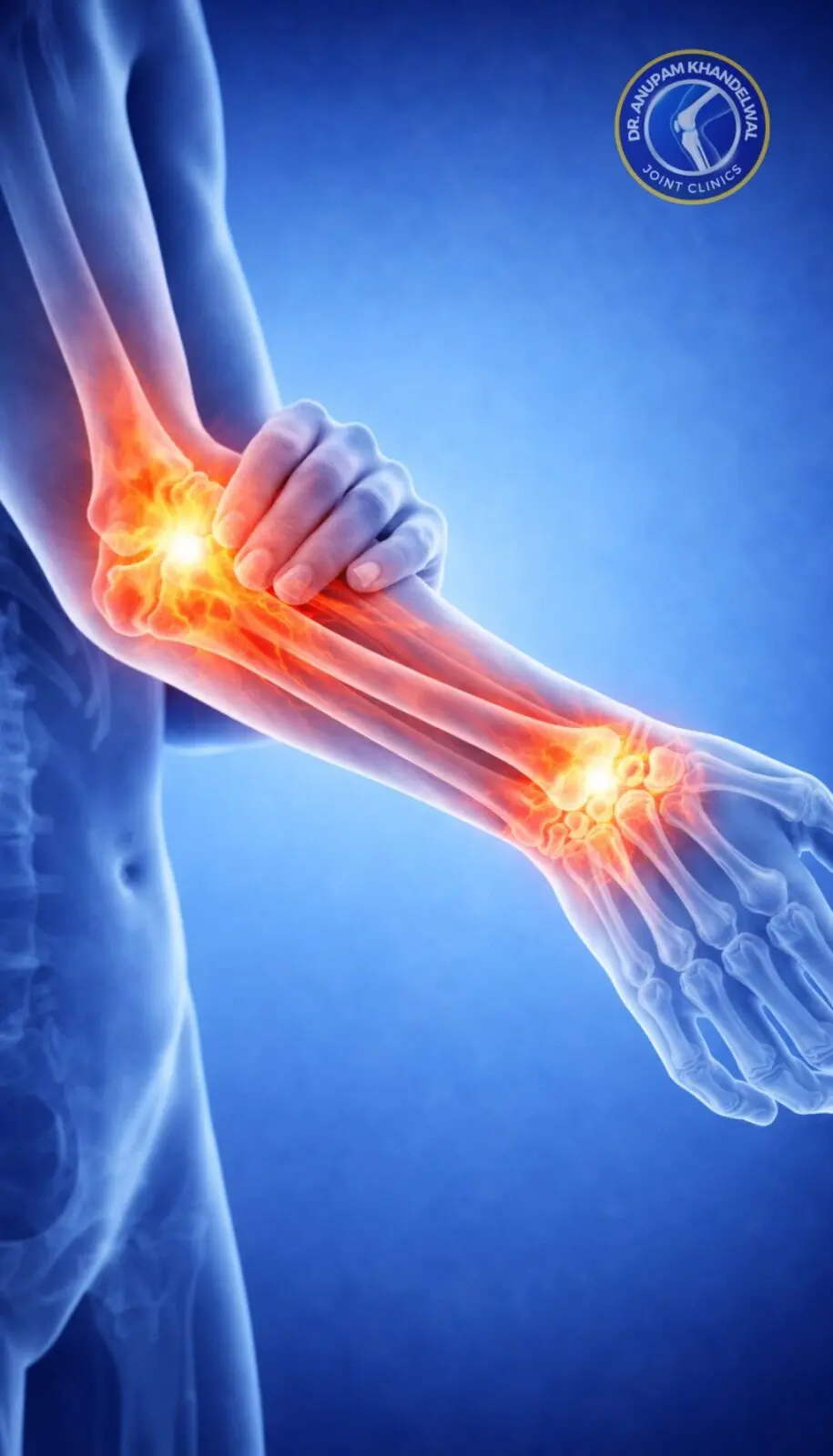
What Makes an Elbow Injury a Terrible Triad?
The term describes a specific unstable elbow fracture-dislocation pattern. Missing one component can lead to undertreatment.
Elbow dislocation
The ulna and radius dislocate from the distal humerus. After reduction, the joint must be checked for concentric alignment and tendency to subluxate again.
Radial head fracture
The radial head supports valgus and axial stability. It may need screw/plate reconstruction or replacement when comminuted and not reconstructable.
Coronoid fracture
The coronoid is an anterior bony buttress against posterior dislocation. Even a small fragment can be important when the elbow is unstable.
Ligament injury
The lateral collateral ligament complex is commonly injured. Medial collateral ligament injury is assessed when instability persists after bony and lateral repair.
High-risk injury
Why Terrible Triad Elbow Injury Is Serious
This injury can redislocate, remain subtly subluxated, become stiff, develop post-traumatic arthritis or lose forearm rotation if stability and joint surface reconstruction are not addressed properly.
X-ray and CT Scan Planning in Terrible Triad Injury
Imaging is reviewed after urgent reduction. A reduced elbow can still be unstable or subtly incongruent.
X-ray Review
- Pre-reduction X-rays document dislocation direction and obvious fracture fragments.
- Post-reduction AP and lateral X-rays confirm whether the ulnohumeral and radiocapitellar joints are concentric.
- Subluxation, widening or incongruity after reduction suggests instability.
- Associated distal humerus, olecranon or forearm injuries are checked.
CT Scan Review
- Radial head fragment number, size, depression and reconstructability.
- Coronoid fragment size, location and involvement of the anteromedial facet.
- Loose intra-articular fragments or mechanical block.
- Joint surface gaps, impaction and radiocapitellar alignment.
- Operative sequence and implant planning.
Bring both X-ray and CT scan images for consultation when a terrible triad injury has been diagnosed or suspected.
When Can Terrible Triad Be Treated Without Surgery?
Non-surgical treatment is uncommon and is considered only when strict stability criteria are met after reduction.
Non-Surgical Criteria May Include
- The elbow is concentrically reduced on X-ray and CT.
- The radial head fracture does not block motion and does not compromise stability.
- The coronoid fragment is small and the elbow remains stable through a functional arc.
- The patient can follow close review, bracing and repeat imaging instructions.
Reasons Surgery Is Usually Considered
- Persistent instability or subluxation after reduction.
- Radial head comminution, displacement or mechanical block.
- Coronoid fragment contributing to instability.
- Large loose fragments inside the joint.
- Need to permit early protected motion by restoring stability.
Surgery for Terrible Triad Elbow Injury
The operation is planned to rebuild the stabilizing ring of the elbow. The exact sequence depends on fracture morphology and intra-operative stability.
Common Surgical Steps
- Radial head fixation using screws or plate when fragments are reconstructable.
- Radial head replacement when the head is severely comminuted and not reliably reconstructable.
- Coronoid fixation or suture-lasso repair depending on fragment size and location.
- Lateral collateral ligament complex repair to restore posterolateral stability.
- Medial collateral ligament repair or hinged external fixation only in selected unstable cases.
Stability Checks
- Elbow reduction must remain concentric through flexion-extension.
- Forearm rotation should not reveal radiocapitellar incongruity.
- Varus-valgus and posterolateral stability are checked after fixation/repair.
- Implant size, especially radial head replacement height, must avoid overstuffing or under-support.
The goal is not only to fix X-ray fragments; it is to restore a stable elbow that can begin safe rehabilitation.
Recovery, Protected Motion and Stiffness Prevention
Terrible triad injuries have a high stiffness risk. Rehabilitation must protect repair while avoiding unnecessary immobilization.
Early Recovery
- Splint or hinged brace positioning is surgeon-specific.
- Protected elbow motion starts when fixation and ligament repair are stable enough.
- Heavy lifting, pushing and weight-bearing through the hand are restricted until healing permits.
- Physiotherapy focuses on controlled flexion-extension and forearm rotation, not forceful stretching early.
Follow-up Concerns
- Repeat X-rays to confirm reduction and implant position.
- Monitoring for stiffness, heterotopic ossification and ulnar nerve symptoms.
- Gradual strengthening after bony and ligament healing.
- Late stiffness may need splinting, therapy or release surgery after full assessment.
Complications That Need Follow-up
Terrible triad is followed carefully because complications can affect elbow motion and long-term hand function.
Early Problems
- Redislocation or persistent subluxation.
- Increasing pain, swelling or neurovascular symptoms.
- Wound or infection concerns after surgery.
- Implant position or radial head sizing concerns.
Late Problems
- Elbow stiffness or loss of forearm rotation.
- Heterotopic ossification.
- Post-traumatic arthritis.
- Ulnar nerve irritation.
- Non-union, malunion or implant irritation in selected cases.
Book Consultation
Book terrible triad elbow injury consultation
Book consultation if X-ray, CT scan or discharge notes mention terrible triad injury, elbow fracture-dislocation, radial head fracture with coronoid fracture, or persistent instability after elbow dislocation.
Bring pre-reduction and post-reduction X-rays, CT scan images, splint details and any notes about nerve, pulse or attempted reduction.