
Elbow Instability and Stiffness Care in Indore
Elbow Dislocation, Terrible Triad and Stiffness
Elbow dislocation and terrible triad injury are stability problems. Post-traumatic elbow stiffness is a common consequence when injury, immobilization or surgery limits motion.
A simple elbow dislocation has no major associated fracture. A complex dislocation includes radial head fracture, coronoid fracture, olecranon fracture, distal humerus fracture or major ligament disruption.
Terrible triad injury classically includes elbow dislocation, radial head fracture and coronoid fracture. Treatment planning focuses on restoring the bony stabilizers, ligament stability and early protected motion when safe.
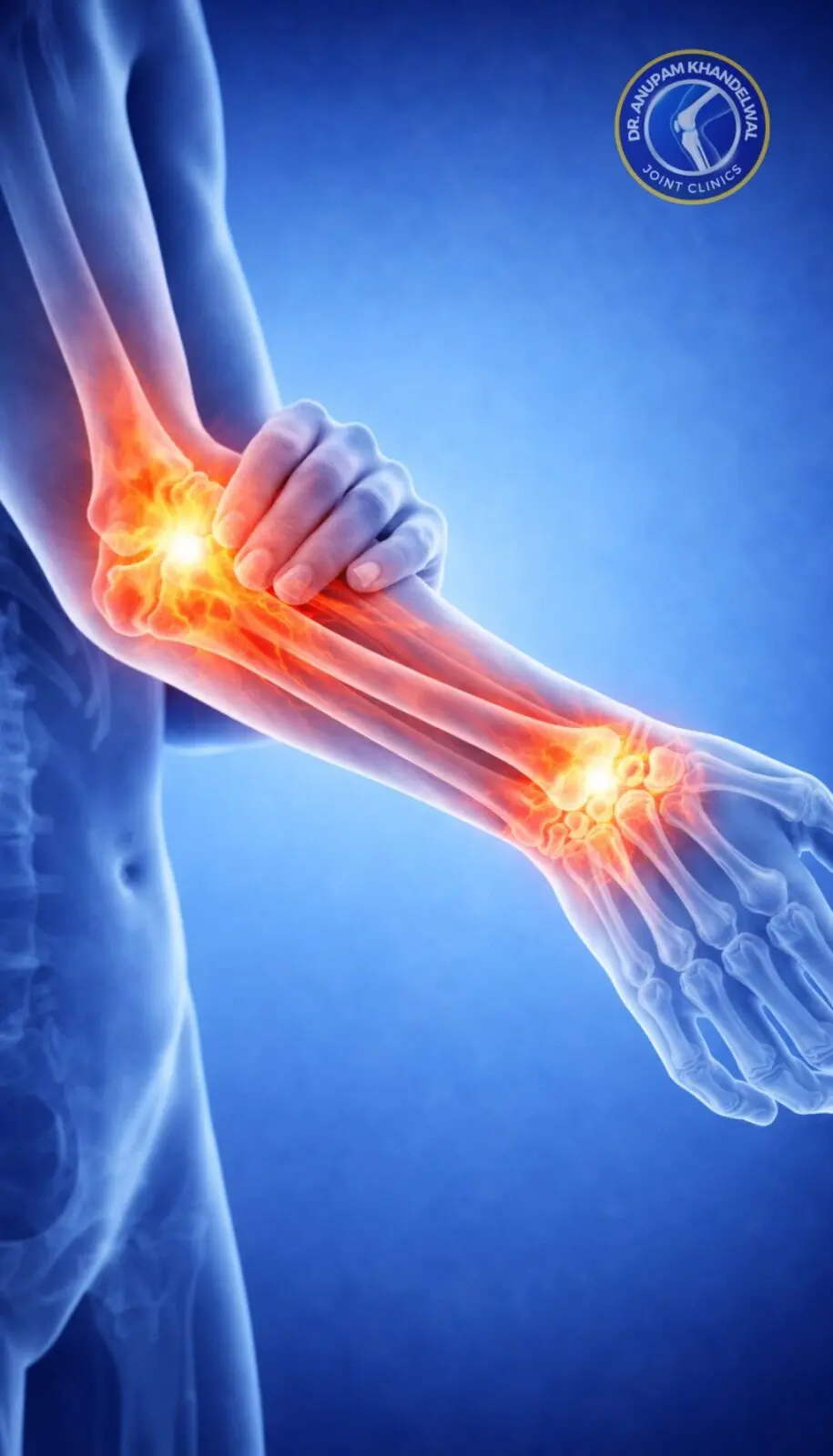
Elbow Dislocation, Instability and Stiffness Patterns
Elbow trauma is classified by whether the joint is reduced, whether fractures are present and whether the elbow remains stable through movement.
Simple elbow dislocation
The elbow comes out of joint without major fracture. After reduction, stability, nerve status and associated ligament injury are assessed.
Complex elbow dislocation
Dislocation with radial head, coronoid, olecranon or distal humerus fracture. CT scan is often needed after reduction.
Terrible triad injury
Elbow dislocation with radial head fracture and coronoid fracture. It has a high instability and stiffness risk if not reconstructed logically.
Posterolateral rotatory instability
Lateral collateral ligament complex insufficiency may cause repeated giving-way, apprehension or recurrent subluxation.
Valgus instability / UCL injury
Medial ligament injury is important in throwing athletes and in dislocation patterns with medial-sided pain or instability.
Post-traumatic elbow stiffness
Loss of extension, flexion, pronation or supination after trauma, surgery, prolonged immobilization or heterotopic ossification.
Simple and Complex Elbow Dislocation
The first goal is safe reduction of the dislocation. The next decision is whether the elbow is stable enough for non-surgical care.
After Reduction Assessment
- Confirm concentric reduction on X-ray.
- Check ulnar, median and radial nerve function.
- Check pulse, hand warmth and capillary refill.
- Assess elbow stability through a safe arc of motion.
Why Complex Dislocation Is Different
- Fracture fragments may block reduction or create instability.
- Radial head loss can reduce valgus and axial stability.
- Coronoid fracture can allow recurrent posterior subluxation.
- Ligament disruption may require repair when instability persists.
Terrible Triad Elbow Injury
Terrible triad injury needs systematic treatment because three stabilizing elements can be injured at the same time.
Components
- Elbow dislocation.
- Radial head fracture.
- Coronoid fracture.
- Frequently associated lateral collateral ligament injury.
Treatment Logic
- Restore or replace the radial head when it is needed for stability.
- Fix the coronoid when fragment size and instability require it.
- Repair the lateral collateral ligament complex when unstable.
- Use protected early motion only when the reconstructed elbow is stable enough.
Terrible triad treatment is individualized. CT scan after reduction is usually important for fragment and stability planning.
Post-Traumatic Elbow Stiffness
Elbow stiffness may follow fracture, dislocation, surgery, prolonged splinting, heterotopic ossification or persistent pain inhibition.
What Limits Motion
- Capsular contracture after immobilization.
- Bony block from malunion, loose body or heterotopic ossification.
- Painful non-union, arthritis or implant irritation.
- Soft tissue scarring around the collateral ligaments or muscles.
Assessment Before Treatment
- Measure flexion, extension, pronation and supination separately.
- X-ray for arthritis, malunion, implants and heterotopic bone.
- CT scan when a bony block or complex articular deformity is suspected.
- Nerve examination, especially ulnar nerve symptoms before release surgery.
Treatment of Dislocation, Instability and Stiffness
Treatment balances stability and movement. Too much instability risks redislocation; too much immobilization risks stiffness.
Non-Surgical Treatment
- Closed reduction followed by stability-based splinting.
- Early protected range of motion when the elbow is stable.
- Hinged brace in selected instability patterns.
- Physiotherapy focused on controlled motion, not forceful stretching in the acute phase.
Surgical Treatment
- Radial head fixation or replacement.
- Coronoid fixation or suture repair in selected patterns.
- Lateral or medial ligament repair / reconstruction.
- Open or arthroscopic contracture release for established stiffness after proper work-up.
- Heterotopic ossification excision only in selected mature, symptomatic cases.
Book Consultation
Book consultation for elbow dislocation, terrible triad or stiffness
Book consultation after elbow dislocation, fracture-dislocation, recurrent instability, terrible triad diagnosis or persistent restriction of elbow movement.
Bring pre-reduction and post-reduction X-rays, CT scan, operation notes, physiotherapy records and details of current range of motion.