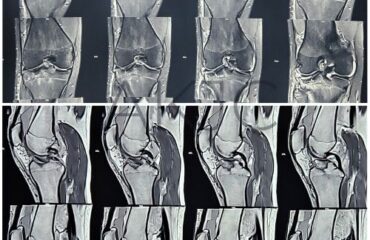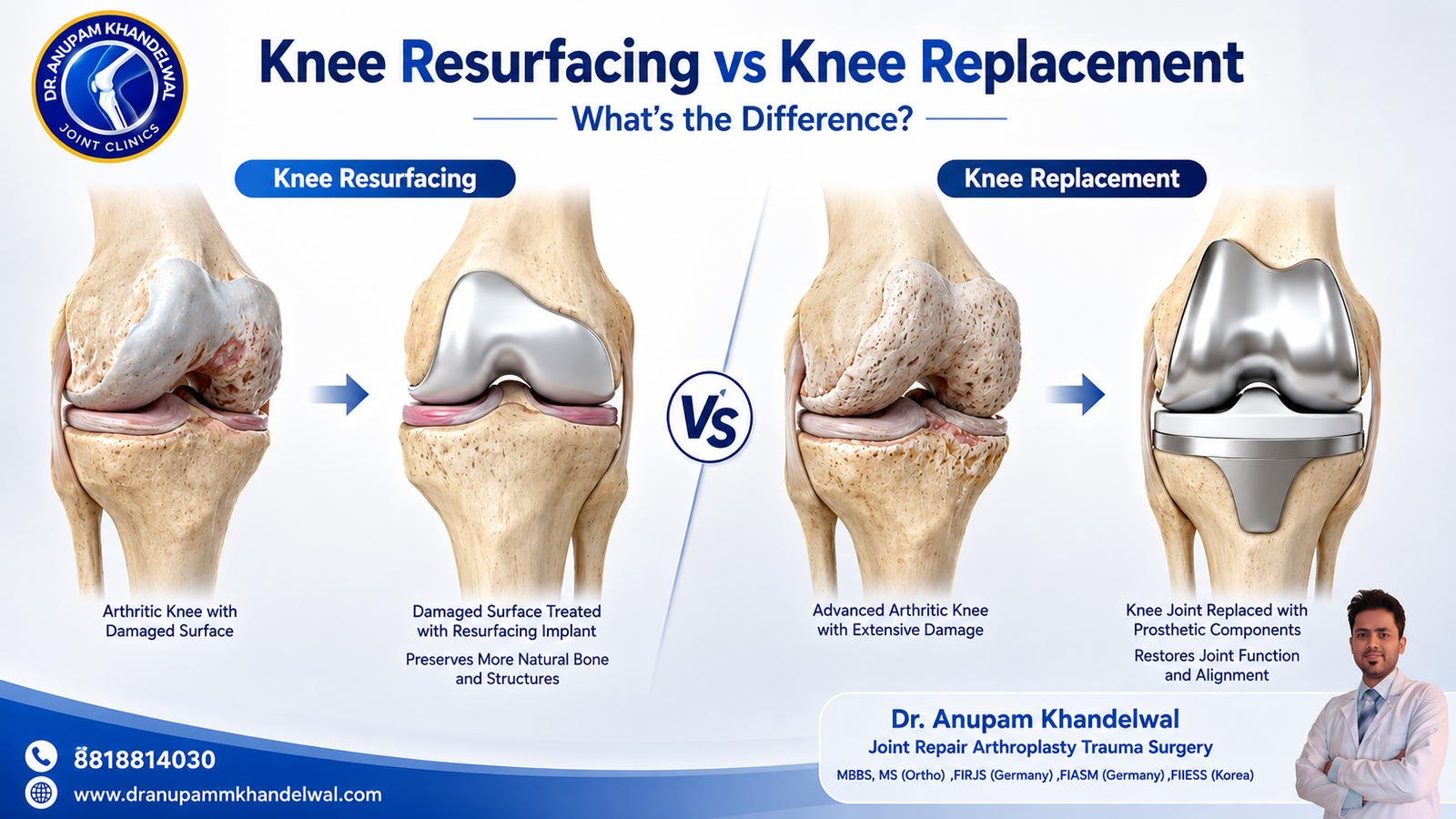
If you have been diagnosed with knee arthritis, you may come across two terms: knee resurfacing and knee replacement. However, are they actually the same procedure? More importantly, which one may be suitable for your knee?
The topic of Knee Resurfacing vs Knee Replacement can be confusing because both procedures aim to reduce pain and improve knee function. Nevertheless, they are not necessarily interchangeable terms. The appropriate treatment depends on the extent of joint damage, knee alignment, ligament stability, bone condition, symptoms, and several other factors.
What Is Knee Resurfacing?
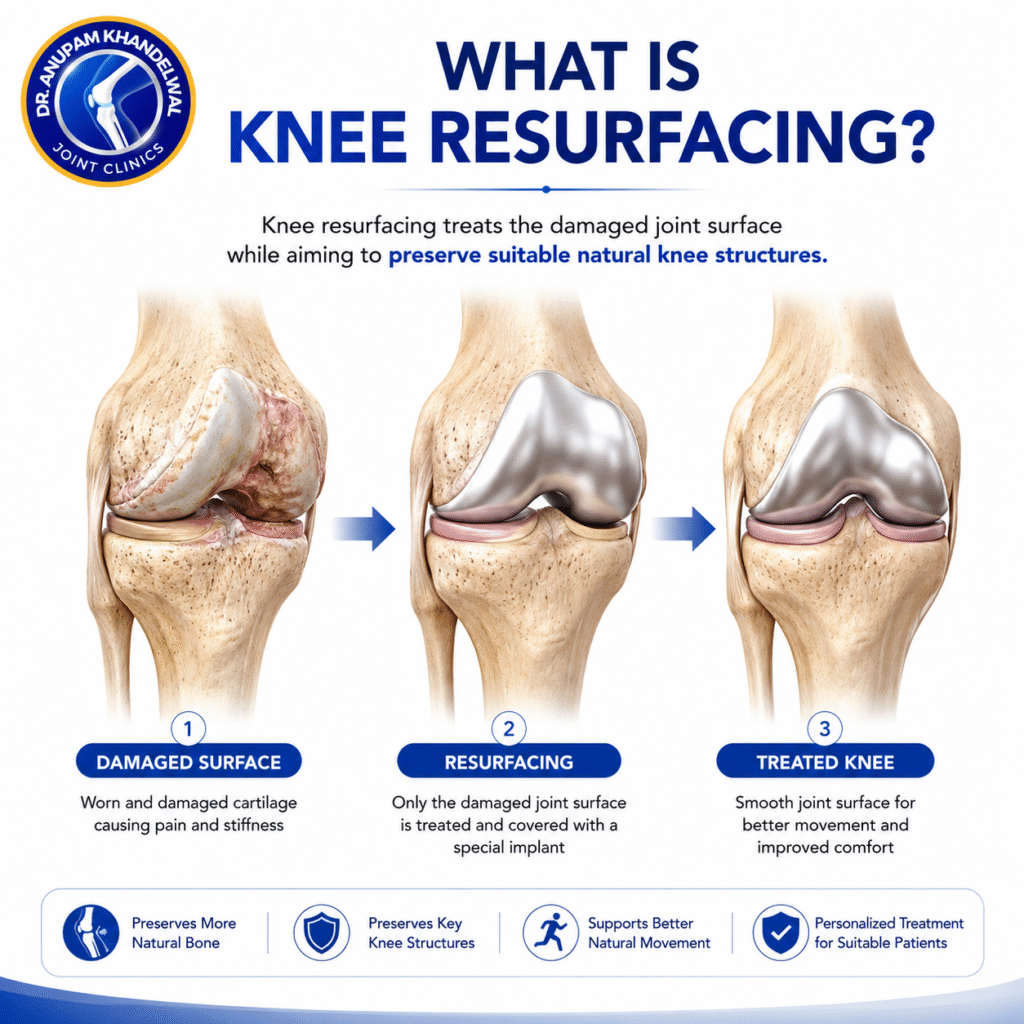
Knee resurfacing generally refers to treating the damaged surfaces of the knee while aiming to preserve suitable healthy bone and joint structures, depending on the specific resurfacing technique being used.
In a healthy knee, smooth cartilage allows the bones to move against each other with minimal friction. Unfortunately, with osteoarthritis, this cartilage can gradually wear away. As a result, patients may develop pain, stiffness, swelling, difficulty walking, and reduced knee movement.
During a resurfacing procedure, the damaged joint surface is addressed and an appropriate implant or resurfacing component may be used to restore the joint surface.
However, the term knee resurfacing can describe different surgical approaches. Therefore, patients should ask their surgeon exactly what type of resurfacing procedure is being recommended and why it is suitable for their particular knee
What Is Knee Replacement?
Knee replacement surgery is a procedure in which damaged portions of the knee joint are replaced with prosthetic components.
A total knee replacement generally involves treating the damaged surfaces of the major compartments of the knee. In selected patients, a partial knee replacement may be considered when arthritis is limited to a particular compartment and other parts of the knee remain suitable.
The main goal is to relieve pain, improve function, correct appropriate mechanical problems, and help the patient return to useful daily activities.
Importantly, knee replacement does not mean that the entire natural knee is simply removed and replaced with a completely artificial joint. Instead, the damaged joint surfaces are prepared and replaced with components designed to recreate the function of the knee.

Knee Resurfacing vs Knee Replacement: What Is the Difference?
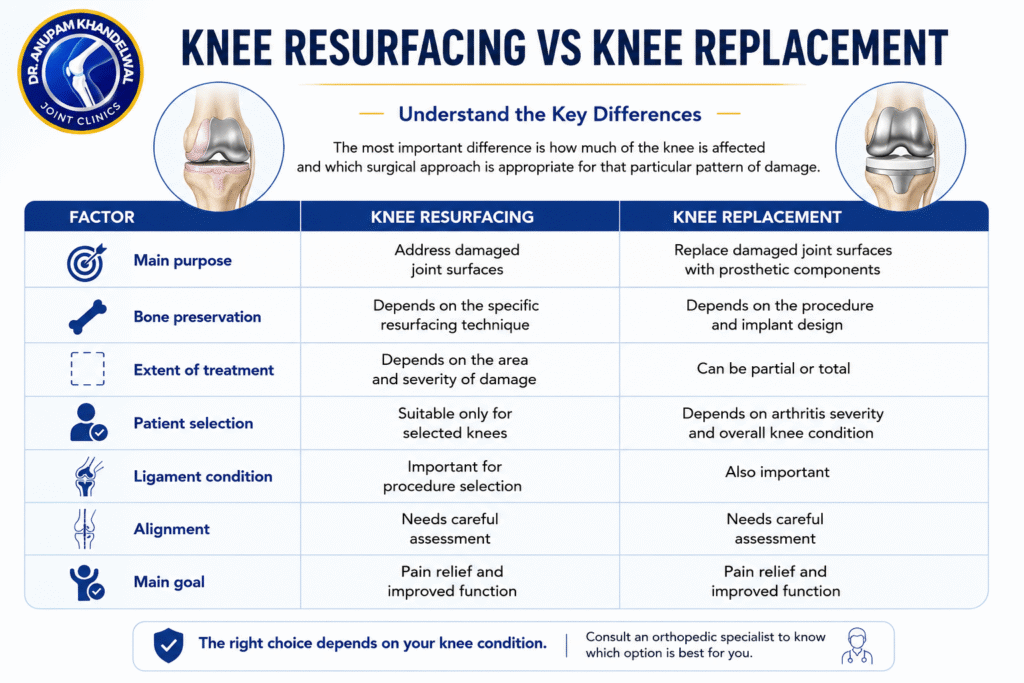
Thus, Knee Resurfacing vs Knee Replacement should not be viewed as a simple competition where one procedure is always better than the other.
Instead, the better question is:
“Which procedure is appropriate for my knee?”
Who Is Best Suited for Knee Resurfacing?
Knee resurfacing is not suitable for everyone with knee arthritis. Instead, patient selection is an important part of treatment planning.
A patient may be considered for a particular resurfacing procedure when
- Arthritis or cartilage damage has a suitable pattern.
- The remaining bone and joint structures are appropriate for the planned procedure.
- The knee has adequate ligament stability.
- There is no major untreated deformity or alignment problem.
- Bone quality is suitable.
- Knee pain is affecting walking, stairs, exercise, work, or other daily activities.
- Appropriate non-surgical treatments have not provided sufficient relief.
- Clinical examination and imaging support the procedure.
At the same time, extensive arthritis affecting multiple areas of the knee, significant bone loss, severe deformity, major instability, or other joint problems may make a more comprehensive replacement procedure more appropriate.
Therefore, age alone should not determine whether someone is a candidate for knee resurfacing. The condition of the individual knee is much more important.
Who Is Best Suited for Knee Replacement?
Knee replacement may be suitable for patients with advanced knee arthritis or significant joint damage when pain and stiffness are affecting daily activities. A patient may be considered for knee replacement when:
- Severe or persistent knee pain affects walking or daily activities
- Arthritis has significantly damaged the knee joint
- Knee stiffness limits movement
- Pain continues despite appropriate non-surgical treatment
- Knee deformity or alignment problems are present
- X-rays show advanced joint damage
- The overall health and bone condition are suitable for surgery
Importantly, age alone does not decide whether knee replacement is appropriate. The final decision depends on symptoms, clinical examination, imaging, joint damage, activity level, and overall health.
Can 3D Knee Resurfacing Be an Option?
Modern imaging and planning technologies can provide additional information about the patient’s knee anatomy. 3D knee resurfacing may be considered in appropriately selected patients when the clinical and imaging assessment supports such an approach.
The purpose of detailed planning is to understand the individual anatomy and damaged areas more clearly and help the surgical team plan the procedure according to the patient’s specific requirements.
Nevertheless, 3D planning does not mean that every patient should undergo resurfacing. Patient selection remains essential.
For this reason, patients should discuss their X-rays, knee condition, treatment alternatives, expected benefits, limitations, and recovery plan with an experienced orthopedic surgeon.
Knee Resurfacing vs Knee Replacement: Which Is Better?
There is no single procedure that is best for every patient.
For example, one patient may have damage concentrated in a specific part of the knee, while another may have advanced arthritis involving multiple compartments. Although both patients may complain of knee pain, their treatment requirements can be completely different. Therefore, the decision may depend on:
- Location and severity of arthritis
- Knee alignment
- Ligament stability
- Bone quality
- Extent of cartilage damage
- Previous knee injuries or surgeries
- Age and activity requirements
- Overall health
- Response to non-surgical treatment
- Patient-specific anatomy
What Happens Before Choosing the Procedure?
Before recommending knee resurfacing or knee replacement, an orthopedic surgeon generally evaluates the patient’s symptoms and medical history. Next, the knee is examined for movement, stability, alignment, tenderness, and deformity.
X-rays and, when necessary, other investigations can then help assess the condition of the joint.
After that, the surgeon can discuss suitable treatment options, including non-surgical treatment and surgical alternatives.
This personalised approach is important because two people with similar knee pain may not require the same procedure.
About Dr. Anupam Khandelwal
Dr. Anupam Khandelwal is an orthopedic and joint replacement surgeon with a focus on Joint Repair, Arthroplasty and Trauma Surgery. He has experience in evaluating and treating patients with knee arthritis, joint pain, sports-related injuries, and conditions requiring joint replacement or joint-preserving procedures.
His clinical approach focuses on understanding each patient’s symptoms, knee condition, alignment, joint damage, bone quality and functional requirements before recommending a treatment option. Depending on the individual case, treatment may include non-surgical care, physiotherapy, joint-preserving procedures, knee resurfacing, partial knee replacement, or total knee replacement.
Dr. Khandelwal holds MBBS and MS (Orthopaedics) qualifications, along with fellowship/training credentials including FIRJRS (Germany), FIASM (Germany), and FIESS (Korea).
For patients considering Knee Resurfacing vs Knee Replacement, a detailed clinical assessment and appropriate imaging can help determine which treatment approach may be suitable for their individual knee.
Frequently Asked Questions
Is knee resurfacing the same as knee replacement?
No. Although both procedures address damaged knee joint surfaces, the surgical approach and extent of treatment can differ. The exact meaning of resurfacing also depends on the technique being discussed.
Is knee resurfacing better than total knee replacement?
Not necessarily. There is no universally better procedure. The appropriate option depends on the patient’s arthritis pattern, knee stability, alignment, bone condition, symptoms, and other individual factors.
Is everyone with knee arthritis suitable for knee resurfacing?
No. Knee resurfacing is suitable only for selected patients. A detailed clinical examination and appropriate imaging are needed to determine whether a particular resurfacing technique is appropriate.
Can severe knee arthritis be treated with resurfacing?
It depends on the pattern and extent of joint damage. When arthritis is extensive or involves multiple areas of the knee, a more comprehensive replacement procedure may be considered.
Does age decide whether I need knee resurfacing or replacement?
No. Age is only one consideration. The condition of the knee, symptoms, activity level, bone quality, ligament stability, and overall health are also important.
How do I know which procedure is right for me?
The best way is to undergo an evaluation by an orthopedic surgeon. Your symptoms, physical examination, X-rays, knee alignment, joint damage, and overall health can help determine the most appropriate treatment.
How do I know which procedure is right for me?
The best way is to undergo an evaluation by an orthopedic surgeon. Your symptoms, physical examination, X-rays, knee alignment, joint damage, and overall health can help determine the most appropriate treatment.
English Summary
Knee Resurfacing vs Knee Replacement are different treatment approaches used for damaged knee joints. Knee resurfacing may be suitable for carefully selected patients with a specific pattern of joint damage, while knee replacement may be considered when arthritis is advanced or more extensive.
The right procedure is not decided by age alone. Instead, doctors consider the severity and location of arthritis, knee alignment, ligament stability, bone quality, symptoms, activity level, and response to non-surgical treatment.
A detailed orthopedic evaluation with appropriate imaging helps determine whether knee resurfacing, partial knee replacement, total knee replacement, or another treatment is most appropriate for the individual patient.
Muhtasari kwa Kiswahili
Knee Resurfacing dhidi ya Knee Replacement ni njia tofauti za kutibu uharibifu wa goti. Knee resurfacing inaweza kufaa kwa baadhi ya wagonjwa waliochaguliwa kwa uangalifu, hasa pale uharibifu wa goti una muundo unaofaa. Kwa upande mwingine, knee replacement inaweza kupendekezwa wakati ugonjwa wa arthritis ya goti umeendelea sana au umeathiri sehemu kubwa ya goti.
Uamuzi wa matibabu hautegemei umri pekee. Daktari huzingatia kiwango na eneo la arthritis, mpangilio wa goti, uimara wa mishipa, hali ya mfupa, maumivu, kiwango cha shughuli na jinsi mgonjwa alivyoitikia matibabu yasiyo ya upasuaji.
Uchunguzi wa kina wa goti pamoja na vipimo vya picha husaidia daktari kuamua kama knee resurfacing, partial knee replacement, total knee replacement, au matibabu mengine yanafaa zaidi kwa mgonjwa.