
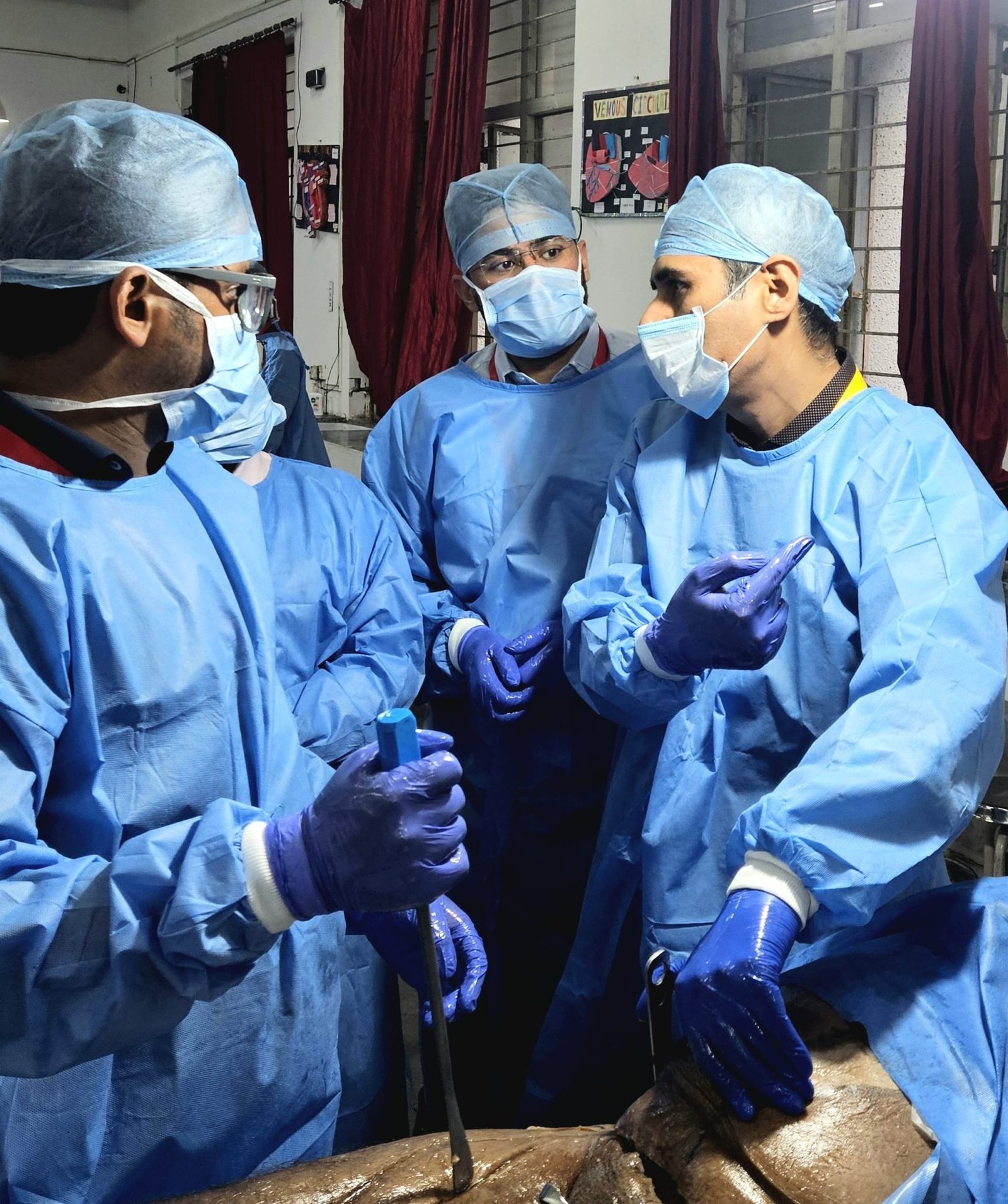
Orthopedic education plays an essential role in improving patient care, especially in the management of complex trauma cases. The Orthopedic Workshop in Bhopal provided an excellent opportunity for orthopedic surgeons, trauma specialists, and postgraduate students to strengthen their knowledge through practical learning and expert discussions.
I am Dr. Anupam Khandelwal, Joint Replacement and Trauma Surgeon from Indore, and it was a privilege to serve as faculty during this intensive Pelvi-Acetabular Cadaveric Surgery Course. The workshop brought together orthopedic professionals from different parts of India with a common goal—advancing surgical skills and improving outcomes for patients suffering from complex pelvic and acetabular fractures.
What Was Covered During Pelvi-Acetabular Course Held in Bhopal Workshop?
The course was carefully designed to provide both theoretical knowledge and practical surgical exposure.
Major topics included:
- Detailed understanding of pelvic and acetabular fracture patterns
- Recent advances in implant systems for pelvic and acetabular fractures
- Posterior and anterior column fracture management
- Hands-on cadaveric dissection sessions
- Live demonstrations of surgical approaches
- Interactive question-and-answer sessions
- Discussion of real clinical challenges and treatment planning
The overall objective was to bridge the gap between textbook learning and real-world surgical practice.
Why Cadaveric Training Is Important
Cadaveric workshops remain one of the most valuable methods of surgical education.
Unlike classroom teaching, cadaveric training allows surgeons to:
- Understand complex three-dimensional anatomy
- Practice surgical approaches safely
- Improve confidence before performing procedures in real patients
- Learn proper implant placement techniques
- Gain practical experience under expert supervision
For pelvic and acetabular fractures, where surgical precision is critical, such hands-on exposure significantly enhances learning.
Why This Orthopedic Workshop in Bhopal Was Unique
Several aspects made this workshop especially valuable for delegates.
Practical Learning
Participants had the opportunity to perform cadaveric dissections, helping them understand pelvic anatomy in a realistic surgical setting.
Live Surgical Demonstrations
Faculty members demonstrated important surgical approaches while explaining anatomical landmarks, reduction techniques, and implant positioning.
Latest Implant Innovations
Discussions included newer implant systems developed for managing complex pelvic and acetabular fractures more effectively.
Nationwide Participation
Orthopedic professionals from multiple states shared their experiences, making the workshop an excellent platform for collaborative learning and professional networking.
My Experience as Faculty
Being invited as a faculty member for this workshop was both an honour and a rewarding experience.
During the academic sessions, I discussed several important topics, including:
- Surgical approaches for complex pelvic fractures
- Decision-making in acetabular trauma
- Practical tips for difficult trauma cases
- Applications of new-generation implant systems
- Common challenges encountered during surgery
One belief has always guided my teaching:
“Knowledge grows when it is shared, and experience remains the greatest teacher.”
The enthusiasm shown by the delegates made every session highly interactive and enjoyable.
Why Pelvi-Acetabular Fractures Are Challenging
Pelvi-acetabular fractures are among the most complex injuries encountered in orthopedic trauma surgery. These fractures involve the pelvis and the acetabulum (hip socket), which are essential for supporting body weight, maintaining stability, and enabling smooth hip movement. Because of the intricate anatomy and the proximity of major blood vessels, nerves, and internal organs, treating these injuries requires careful planning and a high level of surgical expertise.
Most pelvi-acetabular fractures occur due to high-energy trauma, such as road traffic accidents, falls from a height, or crush injuries. In older adults, weakened bones due to osteoporosis may increase the risk of fractures even after relatively minor trauma.
Successful treatment depends on several important factors, including:
- Accurate assessment of the fracture pattern using advanced imaging.
- Choosing the most appropriate surgical approach for each patient.
- Achieving precise reduction and stable fixation of the fractured bones.
- Protecting surrounding nerves, blood vessels, and soft tissues during surgery.
- Planning rehabilitation to help restore mobility and function.
Because every fracture is unique, surgeons must combine sound anatomical knowledge with practical surgical skills and clinical judgment. This is why specialized educational programs such as the Orthopedic Workshop in Bhopal are valuable. Cadaveric training and expert-led discussions provide participants with hands-on experience, improve understanding of complex pelvic anatomy, and help surgeons refine techniques that can contribute to better patient care in challenging trauma cases.
A Shared Commitment to Better Trauma Care
Educational workshops such as this are important because they encourage surgeons to exchange ideas, discuss challenging cases, and stay updated with evolving surgical techniques.
Through continuous learning and collaboration, orthopedic surgeons can deliver safer procedures, improved surgical outcomes, and better rehabilitation for patients with complex fractures.
Strengthening Orthopedic Education Across Madhya Pradesh
Although my clinical practice is based in Indore, I strongly believe in collaborating with orthopedic professionals throughout Madhya Pradesh.
Workshops conducted in cities like Bhopal help create stronger academic connections among surgeons and ultimately benefit patients by promoting evidence-based surgical practices and continuous skill development.
Whether treating patients through joint replacement surgery or participating in trauma education programs, the objective remains the same—improving orthopedic care across Central India.
Looking Ahead
The success of this workshop reinforces the importance of continued medical education.
We look forward to organizing more:
- Cadaveric workshops
- Trauma masterclasses
- Surgical training programs
- Academic webinars
- Orthopedic educational events
These initiatives aim to support orthopedic surgeons, postgraduate students, and trauma specialists in developing advanced surgical skills. You can view more updates and upcoming events / confrence I m attending on my website recent updates .
About Dr. Anupam Khandelwal
Dr. Anupam Khandelwal is a Joint Replacement and Trauma Surgeon based in Indore, Madhya Pradesh. His areas of interest include complex trauma surgery, pelvic and acetabular fractures, hip replacement, knee replacement, and orthopedic education. He regularly participates in academic workshops and surgical training programs to promote continuous learning and evidence-based orthopedic practice.
Frequently Asked Questions
What is a Pelvi-Acetabular Cadaveric Workshop?
It is an advanced orthopedic training program where surgeons learn pelvic and acetabular fracture management using cadaveric specimens under expert guidance.
Who can attend an orthopedic workshop in Bhopal?
These workshops are generally designed for orthopedic surgeons, trauma specialists, fellows, and postgraduate students interested in advanced trauma surgery.
Why is cadaveric training important?
Cadaveric training allows surgeons to practice surgical techniques, understand anatomy more clearly, and improve confidence before performing procedures on patients.
What topics are commonly covered?
Cadaveric training allows surgeons to practice surgical techniques, understand anatomy more clearly, and improve confidence before performing procedures on patients.
Where can I learn about upcoming workshops?
You can visit www.dranupamkhandelwal.com for updates regarding future academic events and educational programs.
About Dr. Anupam Khandelwal
Dr. Anupam Khandelwal is a Joint Replacement and Trauma Surgeon based in Indore, Madhya Pradesh. His areas of interest include complex trauma surgery, pelvic and acetabular fractures, hip replacement, knee replacement, and orthopedic education. He regularly participates in academic workshops and surgical training programs to promote continuous learning and evidence-based orthopedic practice.